









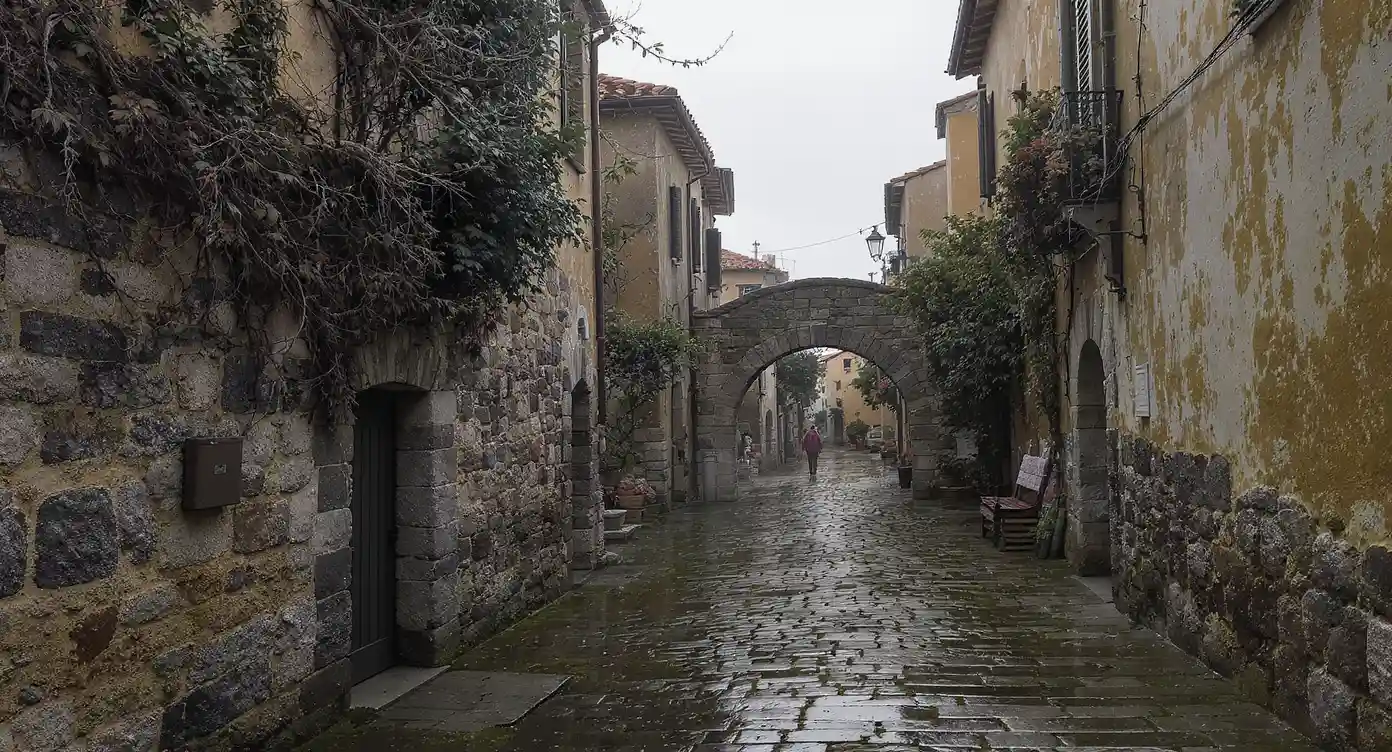
I arrived in Santa Fiora on a November Tuesday, a little before nine o'clock, and the first thing I heard was the water. It runs beneath the streets, in the rigoles, behind the walls. The village clings to the southern slope of Mount Amiata, on the Grosseto province side, and that morning it smelled of wood smoke and wet stone. A woman was shaking a rug at her window. A man was walking down the street with a bag of bread under his arm, without looking at me.
I'll tell you right away: this is not a showcase. The village holds the labels Most Beautiful Villages of Italy and Bandiera arancione, but out of season, nobody is putting on a show. The shutters stay closed, the bars open when they open, and the gray stone of the volcano gives everything a serious air. If you're looking for liveliness, move on. If you like walking slowly and listening, stay.
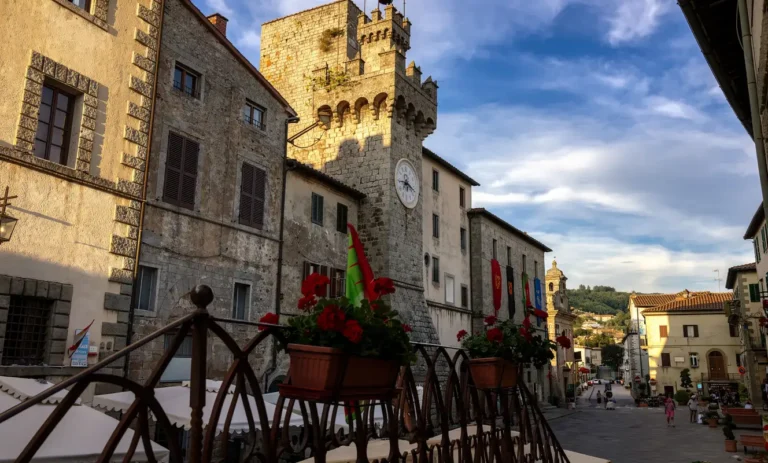
A village of dark stone at the foot of the extinct volcano
Mount Amiata is the highest peak in Tuscany, a former volcano that has not smoked for a long time. You feel it everywhere in Santa Fiora: in the color of the rock, almost anthracite under the rain, in the cold coming down from the beech forests, in the dampness that sticks to your sleeves. I had underestimated the altitude. I had set out in a light jacket, as if for the coast, and I shivered until my first coffee.
I drank the coffee standing, at the counter of a small bar near the square. The owner was talking about firewood with a customer. Nobody asked me where I came from. That's when I understood the rhythm of the day: nothing is rushed, and the village makes no effort to keep you.
Bring a proper jacket, even in a mild autumn. Also bring shoes with good grip, the cobblestones shine as soon as it drizzles.
Getting lost in the three neighborhoods, in the right order
After the coffee, I wanted to see everything at once and went around in circles. Santa Fiora reads in three pieces, and it's best to take them one after the other. Up top, the Castello, around the square and the palace. Lower down, the Borgo, the former ghetto Jewish quarter, with narrow lanes where the daylight barely gets in. And at the other end, Montecatino, calmer still, almost asleep.
My reference point ended up being the porta San Michele, on the Montecatino side. When I no longer knew where I was, I looked for it, and everything fell back into place. I recommend starting at the Castello, going down into the Borgo, then heading toward Montecatino keeping the gate in sight.
In the Borgo, I laid my hand on a cold wall, covered in moss at ground level. A radio was playing behind a door. A cat followed me up three steps, then gave up.
The blue terracotta of the church of Sante Flora e Lucilla
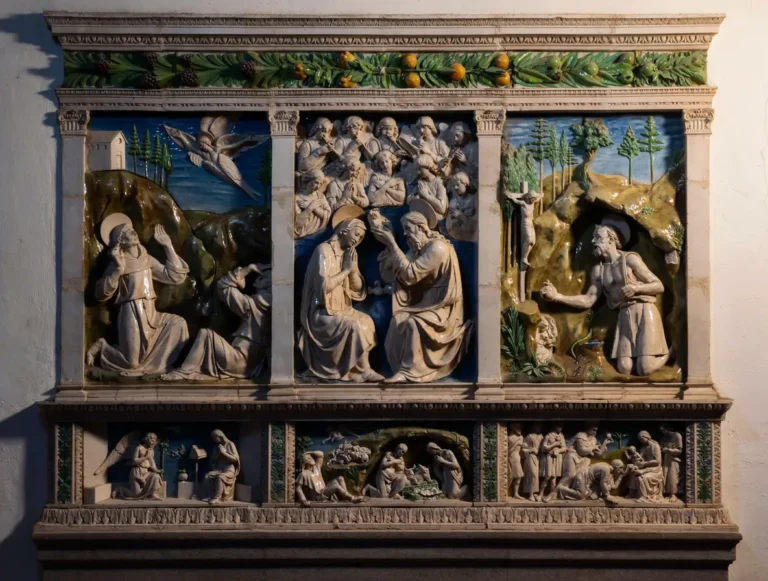
Heading back toward the center, I walked into the church of Sante Flora e Lucilla almost by chance, to warm up. From the outside, nothing prepares you for the shock. Inside, in the dim light, there is that blue. A milky, smooth blue that catches the faintest light, and pure white for the faces.
These are enameled terracottas from the workshop of Andrea della Robbia. I recognized the Baptism of Christ, then the Last Supper, then the Madonna della Cintola, the Virgin offering her belt. After a morning of dark stone, these shiny surfaces have something unreal about them. It's as if porcelain had been set down in a barn.
Don't come here for a spectacular monument. The church is simple. You come for these enamels, and you stay a long time in front of them. Get close to the drapery, look at how the enamel has frozen into little drops along the edges. I came out with the blue still in my eyes.
After hours of gray stone, this Della Robbia blue feels like a window opening onto the sky.
What the rocca and the Sforza palace tell
On my way out, I had in front of me the 16th-century Palazzo Sforza Cesarini, which now houses the town hall. Employees were going in and out with folders under their arms, and I liked that: a great family's palace that still serves a purpose, that hasn't been put under a glass bell.
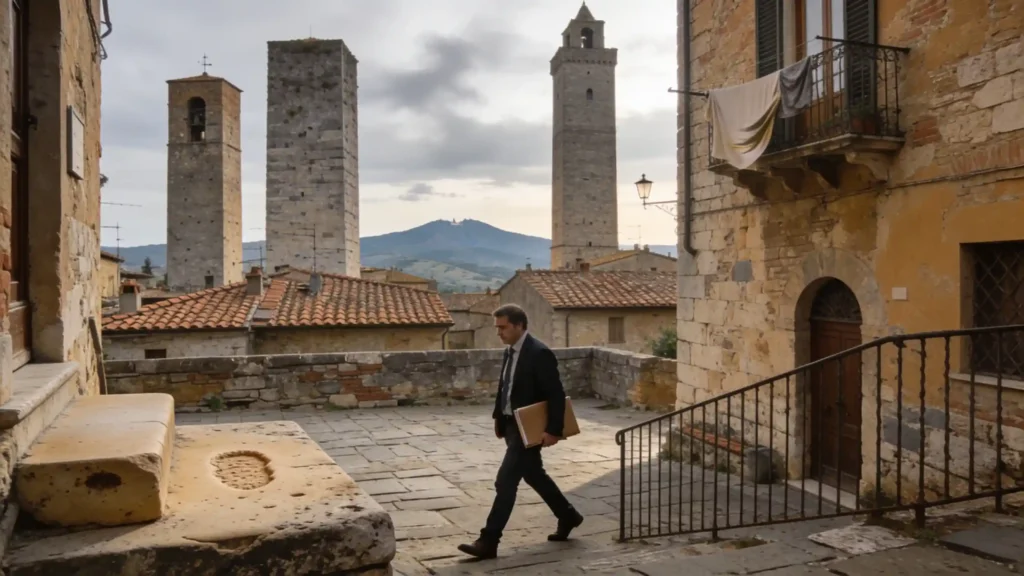
The history of Santa Fiora reads in these walls, layer by layer. First the Aldobrandeschi, lords of the Maremma, who fortified the place at the end of the 11th century. Two massive medieval towers remain of their rocca, which I looked at with my head tilted back under a sky that couldn't make up its mind. Then came a marriage, that of Cecilia Aldobrandeschi to Bosio Sforza, and the village changed hands through an alliance rather than a war. Finally Florence, the Medici, who took control at the beginning of the 17th century.
Dante knew the name. In Purgatory, he exclaims, with bitter irony: « e vedrai Santafior com’è sicura ! » You'll see how safe Santa Fiora is! I reread the line sitting on a step, at the foot of the towers, and I smiled.
Further on, the church of Sant'Agostino keeps a carved doorway from the late Middle Ages, and the church of the Suffragio, later, dates from the early 18th century. Touch the wood of the Sant'Agostino door. It has been polished by centuries of hands.
The palace is nothing like a frozen set piece: people go in with a form in hand, a door slams, someone greets you without knowing you. It serves, quite simply, as it always has.
The rocca aldobrandesca, for its part, chose a different fate. All that remains of it are its two towers, dark and bare, overlooking the historic center. Nobody lines up there for a stamp. You look up, you count the stones, and you understand that this fortress no longer needs to serve in order to stand.
Why Santa Fiora is the town of water
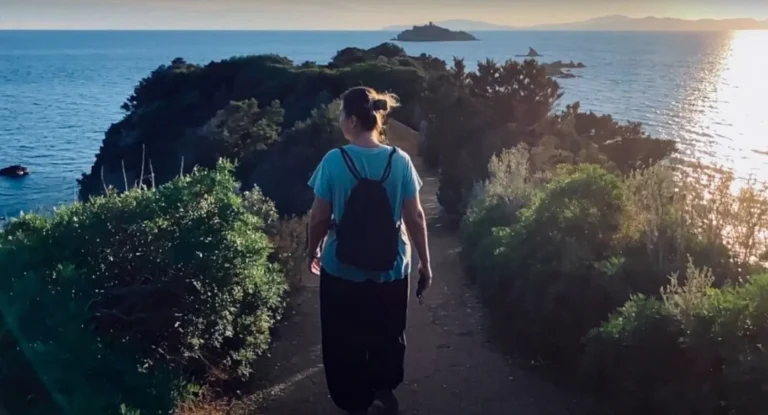
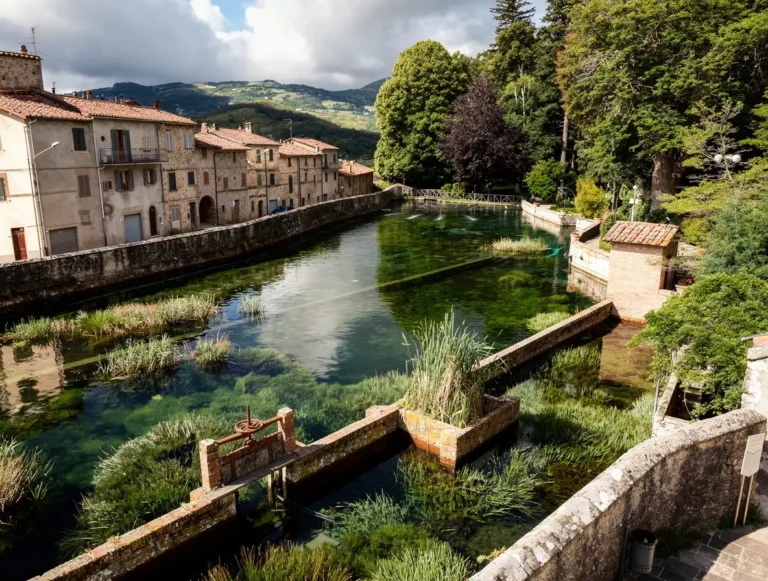
I saved the best for early afternoon. It's called the town of water, and at the Peschiera you understand why. It was a former reservoir where trout were raised, at the foot of the village, right where the Fiora river is born. The water comes out of the mountain, icy and transparent, and fills a large basin surrounded by trees.
I stayed there a long time. The sound is continuous, more a rustling than a lapping. The air was even colder than up above, almost liquid, and carried a smell of wet leaves. The reflections shifted over the stone bottom. A retired couple was walking slowly around the basin, arm in arm.
From there I climbed to the little church of the Madonna della Neve. And there, beneath your feet, there is a glass floor above the spring. You look down and see the water flowing beneath the altar. It took me a moment to dare to walk on it. On the walls, frescoes attributed to Francesco Nasini, in soft colors, watch over this thin stream that feeds the whole village.
Walk gently on the glass. Listen to the water beneath your soles.
Save it for midday: that's when a little light reaches down to the basin and reveals the bottom. In the morning, in winter, everything there stays in shadow.
A break at the table, between chestnuts and mercury
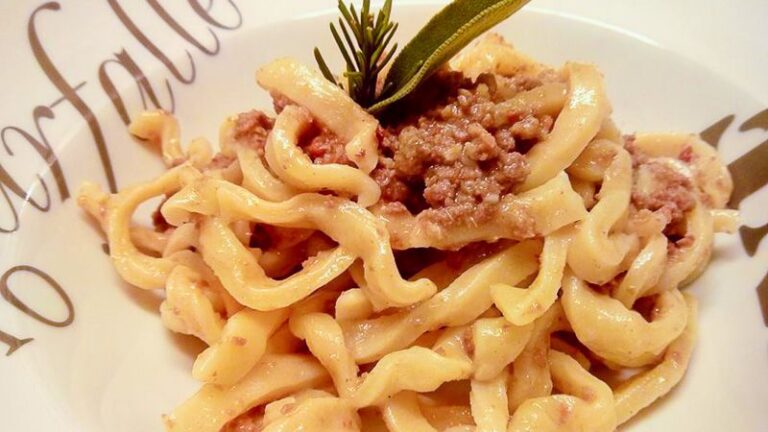
Hunger drew me back toward the center. I didn't look for a specific address; I followed the smell of wood smoke to a small room where a few regulars were eating in silence. In autumn, the Amiata lives to the rhythm of the chestnut trees. Marrone dell'Amiata is protected by an IGP, and you find it everywhere, in flour, in soup, in dessert.
On the table there was also a drizzle of green oil, a little peppery at the finish. It was Seggianese, the DOP oil of the massif. With toasted bread, that was enough to warm me up. Don't look for refinement. We're in the real thing, not the decorative.
This mountain has not always been gentle. For a long time, mercury was mined here, and the Monte Amiata mercury mines museum tells that harsh past, far from the postcard. I didn't go that day, for lack of time. But watching the men's hands at the counter, I thought about it.
If you have a slot more than I did, slip it in there. The museum deserves to be planned in advance, rather than attempted at random at the end of an afternoon, especially out of season, when things open by appointment more often than you'd think.
As for me, I headed back to the square, the taste of oil still on my tongue, with this visit held in reserve for next time.
How long to stay in Santa Fiora, and for whom?
Here is my verdict, without detours. If you love slowness, water, and silent churches, give it a full day. If you only want the old center and the Della Robbias, half a day is enough, provided you don't skip the Peschiera. If you're looking for shops and lively terraces, go elsewhere: you'd be disappointed.
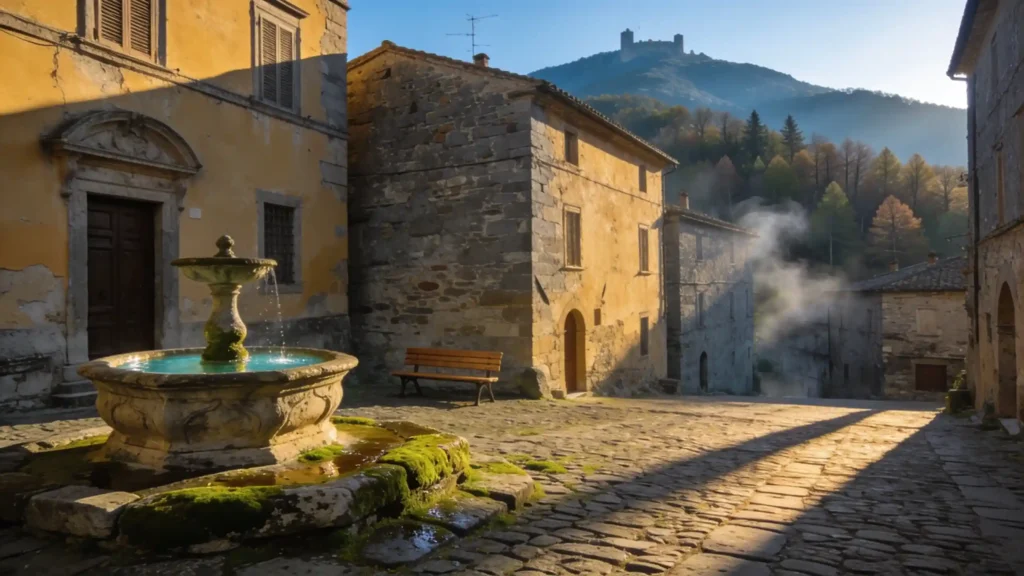
You need a car. The road up toward the Amiata winds a lot, and fog can roll in all at once in cold season. I left around four in the afternoon, already in low light, and I was glad not to be driving at night.
For atmosphere, November gave me the village to myself. Summer is another story: the Palio delle Sante Flora e Lucilla brings the streets to life in July, and the village also celebrates its Processione dei tronchi, a religious festival the locals hold dear.
If you want to combine, you have options around the massif:
- Arcidosso and Castel del Piano, on the same slope, for a different atmosphere of Amiata hill towns.
- Abbadia San Salvatore, on the other side of the mountain.
- Bagnore, very close by, for a short stop.
- The Gorges of the Fiora or the beech woods of Macinaie, if you'd rather end among the trees than in another village.
Don't try to do everything in one day. One addition, no more.
If your stay has to fall around the Palio, the date changes from year to year: a message to the tourist office will give you the one to note before you book anything.
Where to start on arrival
Park up, grab a coffee at the counter, and head straight down to listen to the water, even for just five minutes. Only then climb up toward the Castello and let the blue of the Della Robbia wait for you in the half-light. That evening, back home, I still had the cold of the Peschiera on my fingertips and that sound of water in my head.
Would you rather arrive at dawn, when the mist still clings to the towers of the rocca, or early afternoon, when the light finally touches the bottom of the basin?
To discover the essentials of Santa Fiora, a full day is enough if you arrive by car and take the time to walk without trying to see everything. You can start with a coffee at the counter, explore the Castello, go down into the Borgo and its narrow alleys, then reach Montecatino. Then keep time for the church Sante Flora e Lucilla, where the blue glazed terracottas from Andrea della Robbia’s workshop deserve a real pause, and for the Peschiera, the basin fed by the waters of the Fiora spring. The day works particularly well if you like silent villages, medieval architecture, and walks by the water.
An overnight stay on site or in the surroundings of Mount Amiata becomes interesting if you want to avoid going back on a mountain road after a day of walking, or if you wish to add another village of the massif. You can then plan Arcidosso, Castel del Piano or Abbadia San Salvatore, but it is better to choose only one additional visit rather than turning the stay into a race. For a simple discovery of the old center and the Della Robbia works, half a day may be enough, provided you don’t remove the Peschiera. On the other hand, if you want to feel the local rhythm and enjoy the water, give Santa Fiora its full day. Out of season, check opening possibilities before counting on an interior visit or a specific stop.
The simplest is to visit the three districts in an order that follows the slope, rather than going up and down randomly. Start with the Castello, around the square and the Palazzo Sforza Cesarini, now used as the town hall. Take the time to look up at the two towers of the rocca aldobrandesca, then continue toward the church Sante Flora e Lucilla to see the blue terracottas of the Della Robbia. Then go down into the Borgo, the old Jewish quarter, where the alleys are narrower and often damp. Finish with Montecatino, quieter, keeping the San Michele gate as a landmark.
The San Michele gate is useful when the small streets make you lose your sense of direction: look for it with your eyes and you will more easily find your position in the village. Wear shoes with gripping soles, because the cobblestones can become slippery in the rain or drizzle, and plan a jacket even if the weather seems mild in the plain villages. The visit is best done slowly, stopping in passages and on steps rather than following a too tight schedule. If you want to include the Peschiera and the small church of the Madonna della Neve, keep them for the rest of the walk: they are lower down and require going back up toward the center afterward. This route gives you a coherent visit of Santa Fiora without multiplying useless back-and-forths.
Yes, the Peschiera is worth the detour if you want to understand why Santa Fiora is nicknamed the city of water. This old reservoir, once used to raise trout, is located at the foot of the village, near the place where the Fiora river is born. The mountain water there is cold and transparent, and the basin is surrounded by trees. One comes here less for a spectacular activity than to listen to the continuous sound of water, look at the reflections, and take a break after the stone alleys. The place gives another impression of the village: cooler, quieter, and very different from the squares of the historic center.
To better see the bottom of the basin, try to go around midday, when a little light reaches down to the water. In the morning, especially in winter, the Peschiera may remain in the shade and appear darker. After the basin, you can go up to the small church of the Madonna della Neve: its glass floor allows you to see water flowing under the altar. Move slowly if this sight surprises you, then take time to look at the frescoes attributed to Francesco Nasini. Plan shoes that do not slip and a jacket, because the air by the water may feel colder than in the village. The Peschiera fits easily into a day of visiting, but it deserves more than a quick stop for a photo.
The church Sante Flora e Lucilla is one of the most striking stops of a visit to Santa Fiora, especially if you are interested in religious art and glazed terracotta works. Its exterior remains simple, which makes the contrast with the interior all the more striking: in the half-light, the blue and white surfaces of the works from the workshop of Andrea della Robbia catch the light. The visit route allows you in particular to spot the Baptism of Christ, the Last Supper et la Madonna della Cintola, where the Virgin hands her belt. Take the time to approach the draperies and details of the enamel rather than crossing the church quickly.
This visit is particularly suitable for a day of walking discovery: the church is in the center, on the route between the historic districts, and allows you to take a warm break after a morning spent in the alleys. The travel text does not give opening hours or prices, so do not plan a precise time without checking conditions on site or with the tourist office before your trip. Out of season, openings can be less predictable in small villages, and it is wise to keep some flexibility in your schedule. If you arrive when the church is accessible, allow yourself a few minutes of silence to get used to the half-light: it is often after this moment that the blue of the Della Robbia appears best. A jacket remains useful, because the climate of Mount Amiata can be cool even when the day seems mild.
To organize a visit to Santa Fiora, the car is the most practical choice, especially if you come from the Maremma or if you want to combine the village with other stages of Mount Amiata. The village is located at altitude, in the province of Grosseto, and the mountain road is winding. The journey therefore requires staying attentive, even more so if you are not used to curves or if you are driving on a wet road. Do not rely solely on mild weather near the coast: the air is cooler in Santa Fiora, and fog can fall quickly during the cold season.
Before leaving, plan a warm jacket, shoes suitable for cobblestones, and enough time to drive without rushing. In autumn or winter, avoid if possible planning your return late in the evening: the light drops early and the road can be less pleasant in the dark. A well-organized day consists of arriving in the morning, having a coffee at the counter, visiting the historic center, reaching the Peschiera around midday, then leaving before the light falls. If you don’t have a car, find out in advance about transport options and schedules from your starting point; they are not indicated in the article and it is better not to improvise a connection. To visit several towns of the massif, like Arcidosso or Castel del Piano, having a car also makes the route more flexible. The roads are better suited to a quiet excursion than to a busy tour with many stops.
In autumn, the table of Santa Fiora follows the products of Mount Amiata, in particular the chestnut of Amiata, protected by a PGI. Depending on the places and the current menus, you can find it in flour, in a soup, or as a dessert. The olive oil of Seggiano, also mentioned as a specialty of the massif, simply accompanies grilled bread: it’s a good way to taste a local product without looking for a sophisticated meal. The village lends itself to discreet addresses frequented by locals, but out of season opening hours can be irregular. So avoid building your whole day around a specific restaurant without checking that it will be open, especially during the week or in the late afternoon.
If you have an additional slot, the Monte Amiata mercury mine museum can complete the visit by giving an overview of the mountain’s mining history. The article advises planning this visit in advance, because out of season some openings can be by appointment. For another stop, choose a single place so as not to spend the day in the car: Arcidosso or Castel del Piano are on the same slope, while Abbadia San Salvatore allows you to discover the other side of the massif. If you prefer to end in nature, the Gorges of the Fiora or the beech forests of Macinaie offer an alternative to village visits. Autumn is also a season when cold is felt at altitude: keep a warm layer within reach, even if you plan a break at the table in the middle of the day.
Around this article

Agriturismo & Winery Tenuta Casteani
Want to go further? Tours of Tuscany in the same spirit as this article.
Guided hike: from Florence to Siena and Chianti

Florence to Cortona: Chianti, Siena and Val d'Orcia in 6 days
8 days by bike: Maremma and the vineyards of Scansano
Live map & prices
Where to stay around Santa Fiora?
Our recommended addresses nearby, then today's prices for your dates.
Cars · live prices
Your rental car from Grosseto airport
No rental agencies set up in the villages: the closest agencies to Santa Fiora are in Grosseto. Here are the best current deals, compared and rated.
Searching for available cars…
See all cars and choose my dates
Booking and payment through Discovercars: the link earns us a commission, without changing your price.
Around Santa Fiora
You will also like
Mount Amiata in Winter in 2026: Snow, Skiing, Snowshoeing and What to Do When the Snow Is Lacking
Mont Amiata in winter isn't worth the trip for guaranteed snow:…
Bagni San Filippo in 2026: access, parking and tips for the Fosso Bianco
Bagni San Filippo is a free natural site, open all year round: the…
Florence vs Siena: which one to choose for your 2026 trip?
Siena is the simplest choice for a first short trip to Tuscany…
Eating on Mont Amiata in 2026: chestnuts, porcini and mountain tables
The Mont Amiata IGP chestnut is harvested from mid-September to mid-November,…
