Village
The place
This church is worth the detour to admire an exceptional ensemble of Della Robbia terracottas, set in a well-preserved medieval setting.
👥 Who it's for: Travelers curious about Renaissance religious art and medieval history, in search of authentic mountain villages.
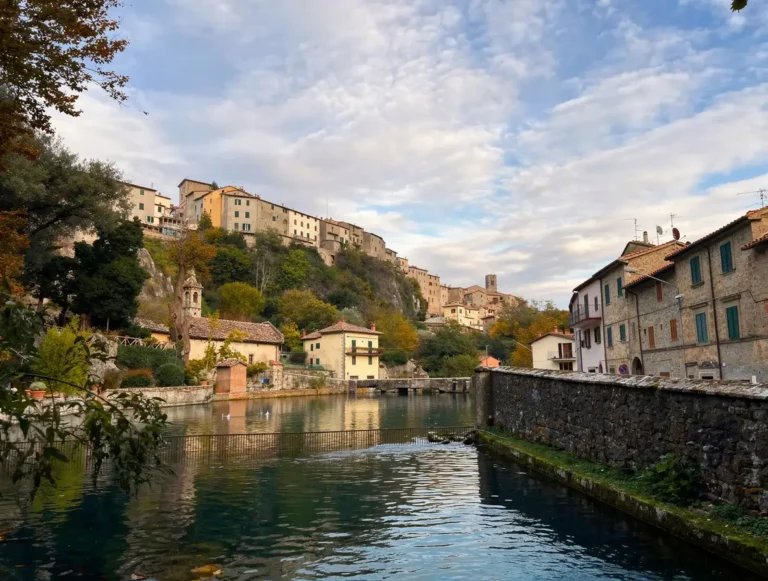
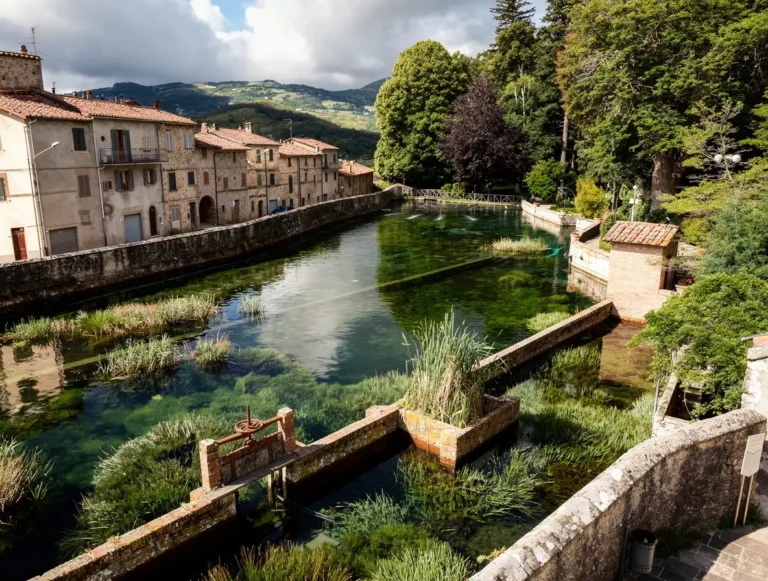
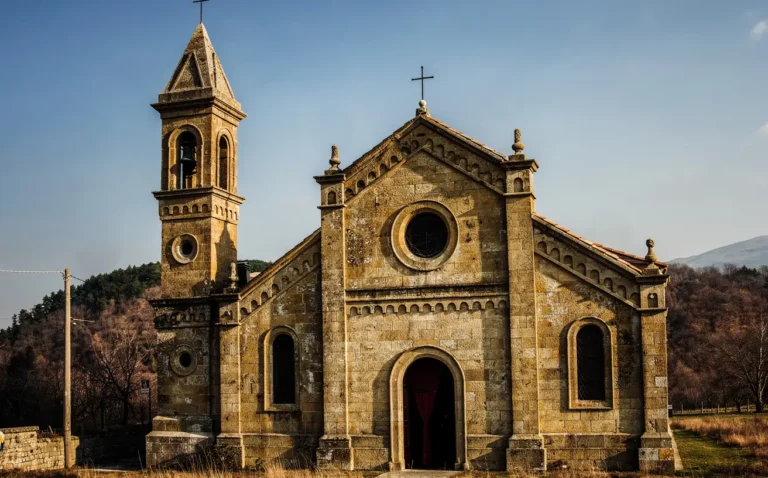
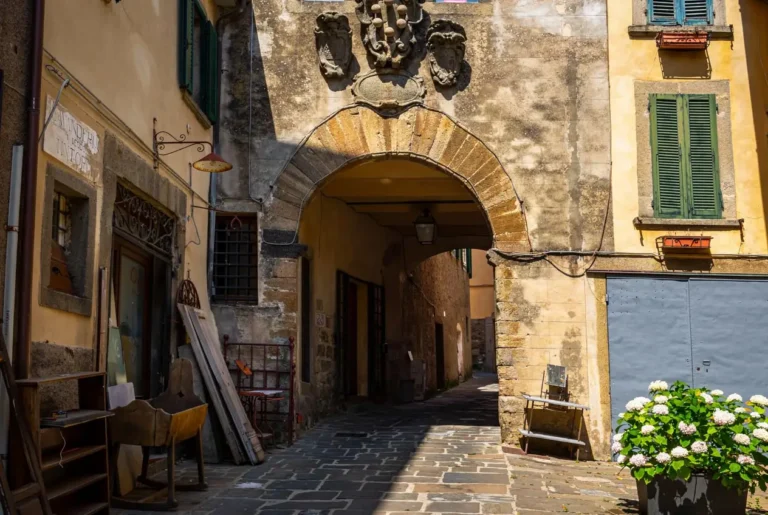
In Santa Fiora, you don't stumble upon this church by chance: the lanes of the old village seem to all lead to it. The Pieve delle Sante Flora e Lucilla stands in the Castello district, at the heart of the village. A small note for the map: Santa Fiora lies in the hinterland of Monte Amiata, in the province of Grosseto, far from the coast. Here the air smells more of cool stone and chestnut than of sea salt.
From the outside, the dark stone façade looks almost austere. Take the time to look up: its large Gothic rose window comes from the former church of San Leonardo, now gone. The Renaissance portal and the coats of arms tell another page of local history. The pieve is mentioned as early as 1142, but the current church dates from the 14th century; enlarged over time, it took its three-aisled plan during works in 1792.
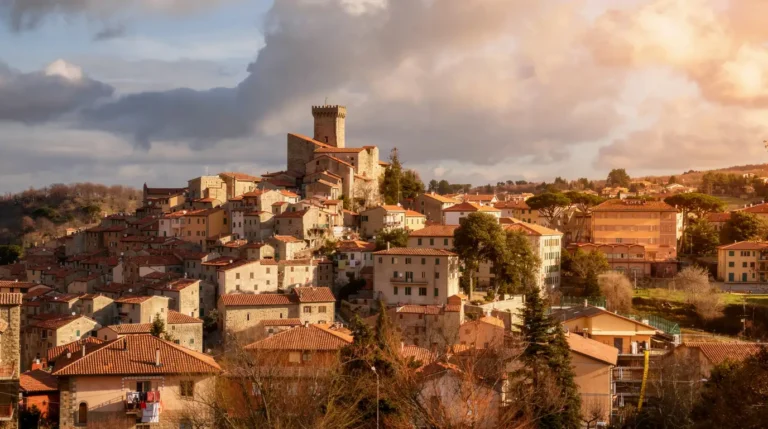
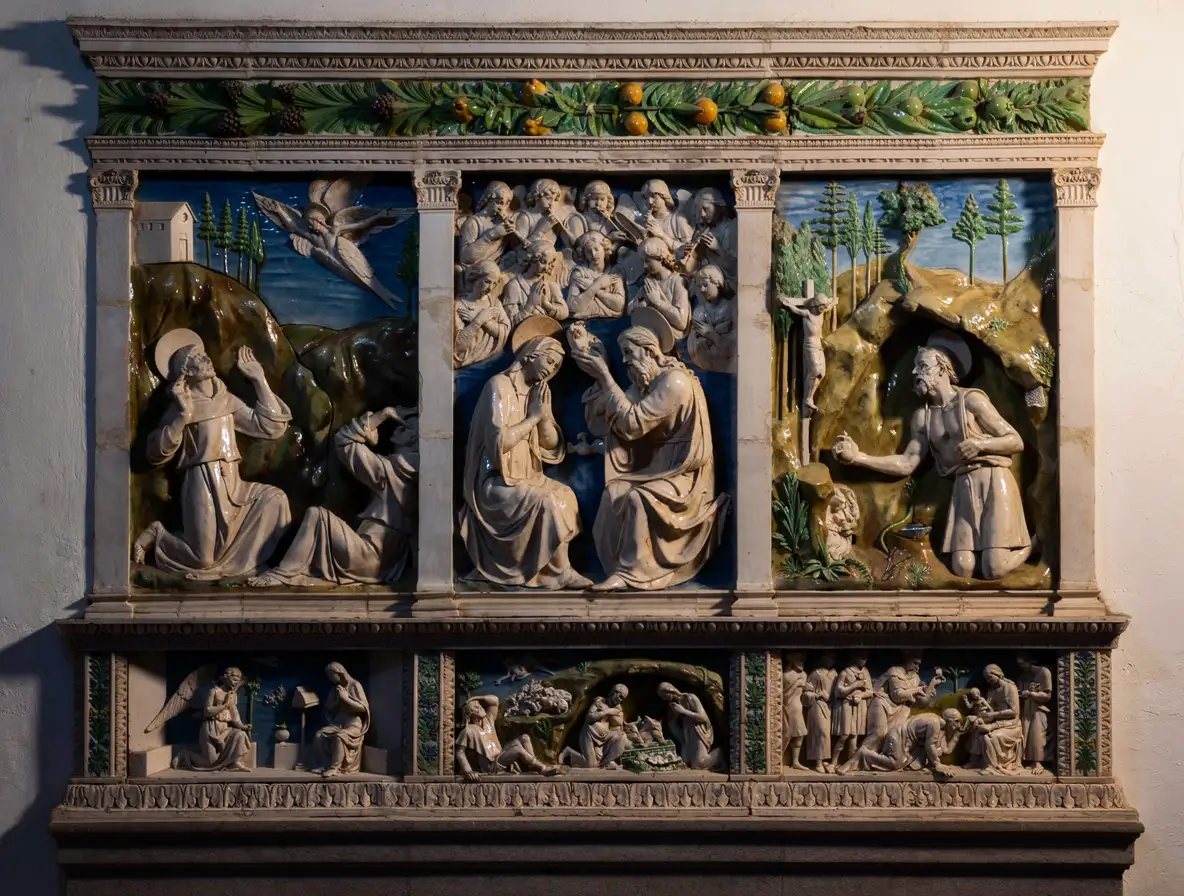
Inside, your eyes slowly adjust to the dim light. Then the white and blue of the glazed terracottas appear, luminous without being showy. Andrea della Robbia and his workshop created this remarkable ensemble between 1464 and 1490. It is not a museum set up apart: the works take their place within the church, amid the customs and memory of a community. To extend your discovery of the region's landscapes and villages, you can read our article on Arcidosso and its medieval village on Mount Amiata.
Start with the Baptism of Christ, near the baptismal font. The scene is framed by a festoon of foliage and fruit: among them you can make out quinces, associated with the Sforza, and chestnuts, the nourishing fruit of the mountain. The detail has something tender about it: sacred history blends here with the landscape and the symbols of local life.
In the central nave, the lectern carries three panels: the Last Supper, the Resurrection and the’Ascension. In the right aisle, your gaze is drawn to the altarpiece of the Madonna della Cintola : the Virgin gives her girdle to Saint Thomas, who arrived too late to witness her departure. Also look for the triptych of theCoronation of the Virgin, flanked by Saint Francis and Saint Jerome. The sharp outlines, the drapery and the small sculpted fruits are best observed without rushing.
The works tell more than the story of faith. They also bear the mark of the powerful who shaped Santa Fiora. The collection was commissioned by the Sforza counts; the reliquary of the patron saints, Flora and Lucilla, recalls the ties between the Aldobrandeschi and Sforza families. It is thought to have been made around 1450 and bears the emblems of several lineages. In this small church, devotion and politics coexist quietly, engraved in the objects as much as in the stone.
Another detail to notice outside: the coat of arms of the Sforza and the Conti di Segni on the façade is said to have been placed around 1547, on the occasion of the marriage of Mario Sforza and Fulvia Conti di Segni. It is these small stories, almost hidden in the architectural details, that make you want to look a second time.
The visit is short, but it deserves a real pause: sit down for a few minutes and let your eyes move from the deep blue of the enamels to the dark stones of the nave. Then extend your walk through Santa Fiora, whose streets converge on the pieve, before letting yourself be drawn to the other treasures of Monte Amiata, such as the Torre Aldobrandesca of Arcidosso and its panorama over the Amiata.
Evaluation criteria
Is the map not displaying? See accommodations on Stay22
Map and prices provided by Stay22: Toscane Cachée may receive a commission on bookings.
To read
 Français Français
 Italiano
 English
 Polski
 Português do Brasil
 Nederlands
 Español
 Deutsch