









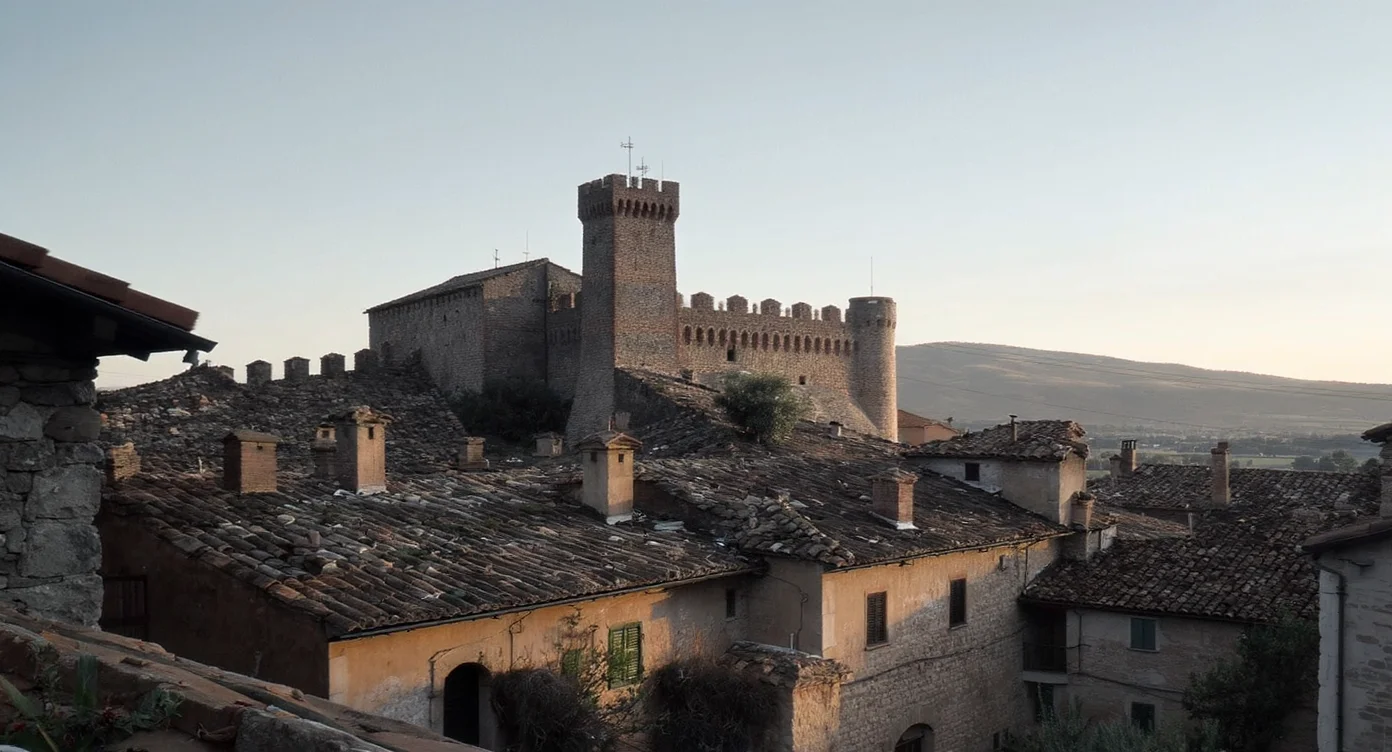

Do you think a village on Mount Amiata boils down to its perched castle, photographed then left behind? Here, the fortress is earned on foot, going up the old town district by district. You first pass through the Terziere del Codaccio, puis sous la Porta Talassese, and you finally come out onto the Rocca Aldobrandesca, which overlooks the rooftops.
Three historical threads guide this walk. The first written mention of the village feeds the hypotheses about the castle's real age; I do not settle this dating debate. The capture of the castle by the Sienese forms the second. The third is the mouvement giurisdavidico, whose trace remains clearly visible in the village.
The Rocca abrite le Museo del Paesaggio Medievale, the Centro Studi David Lazzaretti and the MACO. The opening hours and access conditions change with the season : check them before going up, otherwise you risk finding a closed door. The article follows this path, from the alleys to the museums, before opening onto the surroundings. It does not claim to cover the whole of Mount Amiata.
I leave the car and start with the Terziere del Codaccio, the historic quarter of the old town. You wander through the alleys, with no set itinerary. The Porta Talassese keeps the trace of the ancient fortifications of Arcidosso. Cross it thinking about what it protected. A little further on, the Chiesa di San Niccolò, a medieval church, lets you catch your breath.
In front of the Rocca, history does not fit into a single date
The text and the stones do not tell the same story.
 Etruscan Tuscany
Rocca Aldobrandesca di Arcidosso
Arcidosso (GR)
Telling the story of a castle whose origins remain debated
The village is attested in writing in 860, in a deed linked to the abbey of San Salvatore. On the Rocca side, the municipality probably dates its construction to around 860, while Visit Tuscany rather mentions a nucleus around l’an 1000 and a possible stone palace between 970 et 995. The Aldobrandeschi enlarge the towers and two crenellated walls. 1. . En 1331, the Sienese take Arcidosso after the siege led by Guidoriccio da Fogliano.
Inside the castle, I change scale: from the medieval landscape to singular stories
Climbing the Rocca Aldobrandesca and looking at the Amiata differently
The Museo del Paesaggio Medievale teaches you to read the Amiata and the Maremma from pieces of Castel Vaiolo, from archaeological research. Then climb up into the Torre Aldobrandesca 1. : the view from the summit carries far.
 Etruscan Tuscany
Museo del Paesaggio Medievale
Arcidosso (GR)

Tosco At Castello 2. Aldobrandesco, you're not just looking at objects: you learn to read the Amiata as an inhabited landscape. And those medieval chestnut trees of Castel Vaiolo, what a detail to make history concrete!
Discovering two other stories housed in the castle complex
The Centro Studi David Lazzaretti 3. retraces the Giurisdavidic movement, with objects and documents as evidence. As for the MACO4. , housed in the Palazzo della Cancelleria, it turns its gaze toward the East. No posted rates here, and the opening hours change with the season.
 6,6
My walking route, without turning Arcidosso into a checklist
6. I don't check anything off: I walk, and I stop when an alleyway invites me to.
Keeping a simple thread between the alleys, the Rocca and the surroundings
Je pars du Terziere del Codaccio7. , then I pass through the Porta Talassese and the Chiesa di San Niccolò8. . The climb stops at the Rocca Aldobrandesca9. , at the top of the old town. Afterwards, I check the opening hours of the MACO 10. : they change according to the season. The Mount Amiata 11. and the Maremma, I let them extend the walk, with no obligation.
 Etruscan Tuscany
Porta Talassese
Arcidosso (GR)

Tosco The Porta Talassese is the kind of gateway you could walk through without thinking about it: slow down under the arch and picture the inhabitants who once returned to the fortified village. Then climb up to the Rocca Aldobrandesca, just above!
Arcidosso is best discovered without rushing
12. Arcidosso doesn't need a tight schedule. Between the alleyways of the old town and the Rocca Aldobrandesca13. , the climb fills a morning effortlessly, provided you stop at every little square. As for museums, it's better to choose according to your mood of the day than to rush through them all. Un seul14. , visited without rushing, leaves more memories than three hurried ones.
15. Before leaving, 16. check the MACO opening hours17. , which change according to the season. One more thing: the register I have does not contain 18. any business address 19. (restaurant, accommodation, guided tour) for this area. So I mention none rather than invent one.
20. The rest belongs to the Mount Amiata et à la Maremma neighbor. You can explore them in the afternoon if your legs are up to it, or save it for another time. A village like this one, you'll gladly come back to.
To discover Arcidosso on foot, start at the Terziere del Codaccio, one of the historic quarters of the old town. Here, it is best to move along quietly and follow the alleys that catch your eye rather than trying to stick to a rigid route. Walking gradually takes you uphill and lets you see the village as a whole of quarters, passages and small squares, rather than as a mere backdrop around the castle. Take the time to look at the façades and the details of the alleys: this progression is also what gives depth to the visit.
Continue towards the Porta Talassese, a remnant of the ancient fortifications, then take a break at the Chiesa di San Niccolò, a medieval church located along the way. The climb then continues up to the Rocca Aldobrandesca, which overlooks the old town. This sequence forms a simple thread for visiting the medieval village without multiplying detours: historic quarter, ancient gate, church, fortress. The article does not give a starting address or precise parking instructions; so avoid relying on a particular car park without checking on site. Plan shoes suitable for the alleys and the climb, and keep some time to stop along the way. The walk can fill a whole morning without any need to rush.
Not necessarily. The date of 860 corresponds to the first known written mention of Arcidosso, in a deed linked to the abbey of San Salvatore. It attests to the existence of the village at that time, but does not by itself allow the construction of the Rocca Aldobrandesca to be dated precisely. It is useful to distinguish these two landmarks during the visit: the written history of the borough and that of the castle’s first buildings do not necessarily coincide.
The hypotheses about the fortress differ. One dating places its construction probably around 860, while another envisages a core around the year 1000 and a possible stone palace between 970 and 995. The Aldobrandeschi then enlarged the complex, notably with towers and two crenellated walls. Rather than looking for a single date carved in the stones, observe the Rocca as a whole that has evolved over time. Another well-identified episode is the capture of Arcidosso by the Sienese in 1331, after the siege led by Guidoriccio da Fogliano. This eventful history gives particular interest to the climb from the alleys: the castle is not just a viewpoint, but the heart of a medieval story whose beginnings remain debated. The article reports the various hypotheses without deciding between them, which avoids presenting an interpretation as a certainty.
For a first discovery of Arcidosso, plan a morning if you want to walk without hurrying from the old town to the Rocca Aldobrandesca. The time will depend above all on your breaks: the alleys of the Terziere del Codaccio, the Porta Talassese et la Chiesa di San Niccolò invite you to slow down even before reaching the castle. The article does not give a timed duration for each section of the route; it is therefore better to keep some leeway rather than build a tight schedule around precise times.
Within the complex, you will find the Museo del Paesaggio Medievale, the Centro Studi David Lazzaretti et la MACO, housed in the Palazzo della Cancelleria. Visiting all of them in a row may require more time than the simple stroll, but the article provides neither visit durations nor fixed opening hours. It advises choosing according to your interest of the moment: archaeology and the medieval landscape, the history of the Giurisdavidic movement, or Eastern culture. Opening hours and access conditions change with the season; check them before setting off to avoid finding a closed door. No prices are given in the article, so do not plan on a precise amount on that basis. If you only have a morning, prioritize the walk and one museum, then keep the rest for another visit. This way of doing things leaves more room for unexpected discoveries in the village.
The best choice depends on what attracts you, because the three spaces mentioned in the article tell different stories. To understand the landscape of the Amiata and its medieval past, head for the Museo del Paesaggio Medievale. It draws notably on pieces from archaeological research at Castel Vaiolo and helps to link the remains to their territory. If you prefer to delve into local history and religious and social movements, the Centro Studi David Lazzaretti presents the Giurisdavidic movement through objects and documents.
The MACO, housed in the Palazzo della Cancelleria, offers a gaze turned towards the East. It can therefore be an interesting choice if you wish to vary the themes compared with the medieval alleys and the history of the fortress. There is no, in the article’s information, any universal recommendation or comparison of duration between these visits: choose rather according to your wishes of the day and the time available. Opening hours and access conditions change with the season, so check them before climbing up to the Rocca. The article gives no prices; it is better not to plan on a precise price without up-to-date information. If you hesitate, keep in mind that a single museum visited unhurried can be more memorable than three rooms rushed through. The tower and the collections offer different experiences, which you can also spread over two visits to Arcidosso.
Yes, if you feel like gaining some height after walking through the alleys of the old town. The Torre Aldobrandesca, integrated into the Rocca Aldobrandesca, rises to 28 metres and offers a view advertised as 360°. It is a way of changing scale: after observing the passages, the ancient fortifications and the buildings up close, you can look at the village and the surrounding landscape from the top. The experience rounds off a visit to Arcidosso well, especially if you are as interested in the territory as in the castle.
To make the most of the climb, do not treat it as an obligatory photo stop to rush through. It fits naturally into the walk that starts from the Terziere del Codaccio, passes through the Porta Talassese and leads to the Rocca. Opening hours and access conditions to the castle’s spaces may vary according to the season; check them before planning the tower as the centrepiece of your day. The article does not specify the number of steps, accessibility, possible restrictions or the entrance fee. If mobility or access to heights are important criteria for you, do not assume the tower is suitable without obtaining confirmation before the visit. In favourable weather, allow yourself a pause at the top to observe the surroundings without trying to turn this stop into a full excursion of Mount Amiata: Arcidosso is a fine discovery in its own right, and the surroundings can extend the day depending on your energy.
You can consider devoting the morning to Arcidosso, then extending your day in the Mount Amiata or the Maremma, but the article does not describe a detailed itinerary between the village and wild hot springs. It gives neither distances, nor travel times, nor access conditions to hot springs. It is therefore better to treat this combination as an idea to be organized separately, rather than assume the hot springs are a few minutes from the centre. The visit of the village, for its part, lends itself well to a quiet half-day: a walk in the old town, discovery of the Rocca, then possibly a museum depending on opening hours.
Before planning the baths, check their exact location, access conditions, the state of the roads and any local rules; this information does not appear in the content devoted to Arcidosso. For the village part, keep as your thread the walk from the Terziere del Codaccio to the Porta Talassese, the Chiesa di San Niccolò et la Rocca Aldobrandesca. Also check the seasonal hours of the MACO if you wish to enter it, as opening hours may change. The article does not mention any accommodation, restaurant or activity address around Arcidosso; it would therefore be unwise to build a programme on unspecified addresses. If you want to enjoy both experiences without rushing, choose one single museum in advance and keep enough leeway for the rest of your day.
Around this article
 €€ 5,0/10 · 5 reviews
 Wine tasting
Seggiano: Visit to a typical Tuscan farm with olive oil tasting
Seggiano
Tosco Seggiano is the kingdom of the Olivastra Seggianese, a unique olive variety that grows on the slopes of Mount Amiata: get ready for an oil that is far more herbaceous and lively than the Chianti classics!
 €€ Wine tasting
Olio Abbraccio olive oil tasting in Seggiano
Seggiano
Tosco Seggiano est le berceau de l' *Olivastra Seggianese*, une variété unique qui donne une huile incroyablement douce et fruitée : prépare-toi à "slurper" comme un pro pendant la dégustation pour bien l'aérer en bouche !
 €€ 4,8/10 · 36 reviews Wine tasting
Seggiano: Guided tour of the olive grove and food tasting
Seggiano
Tosco Seggiano is home to the Olivastra Seggianese, a unique olive variety that grows only on the volcanic slopes of Mount Amiata: expect an oil that is much softer and creamier than the spicy great crus of Chianti!
 €€ Hiking
Hiking on Mount Amiata with Controsole Trekking
Mont Amiata · Abbadia San Salvatore (probable, lieu de départ Prato delle Macinaie)
Tosco Climbing this ancient volcano in the coolness of the beech trees is a complete change from postcard Tuscany, but don't underestimate the 5.5 hours of walking: bring real trekking shoes and a windbreaker for the summit!
Is the map not displaying? See accommodations on Stay22
Map and prices provided by Stay22: Toscane Cachée may receive a commission on bookings.

Tosco Save the Aldobrandesca tower for last: its 28 meters of steps must be earned, but the 360° panorama over the Maremma and the Amiata is worth the effort — if your legs agree!