Rome Ciampino
2 h 02 drive to Orbetello · 157 km
Flights, train, car
Pisa, Florence or Rome: the airport that really brings you closer to your village, the direct flights found, Ryanair included, and the train to Grosseto.
Find my airport ↓The tool
Your departure city, your village, your month: we rank the airports by the direct flights found and the drive you'll have left.
2 h 02 drive to Orbetello · 157 km
2 h 09 drive to Orbetello · 142 km
2 h 40 drive to Orbetello · 204 km
2 h 54 drive to Orbetello · 193 km
Compare
Ryanair does not appear in this comparison: its direct flights are in the tool above.
Train
Grosseto is the main railway station in Maremma. From there, continue by bus or rental car.
The station is in the terminal (Pisa Aeroporto, PisaMover shuttle to Pisa Centrale), then the coastal train.
From the airport, T2 tram to Santa Maria Novella (≈ 20 min), then the train via Siena or along the coast.
The station is in the Fiumicino terminal: train to Rome, then the coastal Intercity to Grosseto.
From Ciampino, shuttle to Roma Termini (≈ 40 min), then the coastal Intercity to Grosseto.
Searches dated and pre-filled with our partners (timetables, prices and tickets on their site). Partner links: they earn us a commission without changing your price.
On the spot
The guide
The wild south of Tuscany takes a bit of effort: first you need to choose which airport to fly into.
It all depends on where you sleep: between Massa Marittima and Pitigliano, the most convenient airport changes. In this article, we compare Pisa, Rome and Florence, with travel time, price and transport options. For your specific case, the tool at the top of this page ranks the airports according to your city and your village.
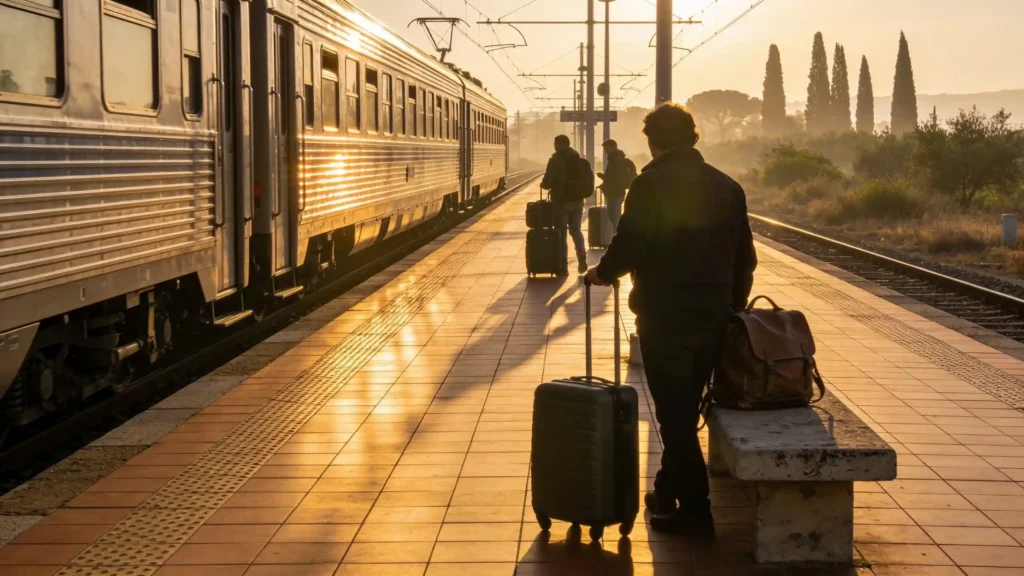
By train, Pisa is the simplest. The PisaMover links the airport to Pisa Centrale in 5 minutes, every day from 6 a.m. to midnight, so there's no need for a taxi.
Direct trains leave Pisa Centrale for Grosseto, taking 1 h 30 to 2 h depending on the timetable. You don't have to change on the way.
By car, it all depends on the village. Pisa wins for the north: 2 h 03 to Grosseto, 1 h 47 to Massa Marittima. For the south, Rome comes out ahead: from Fiumicino, allow 2 h 09 to Orbetello and 2 h 28 to Pitigliano, compared with 2 h 40 and 3 h 14 from Pisa.
By train, Rome is less direct: you take the Leonardo Express to Roma Termini, then change for Grosseto.
Compare the price and arrival time for the same dates. For renting a car in Pisa, read the tips for renting in Pisa without getting ripped off.
North of Grosseto, aim for Pisa. South of it, aim for Rome. And a late flight will cost you a day, wherever you're going.
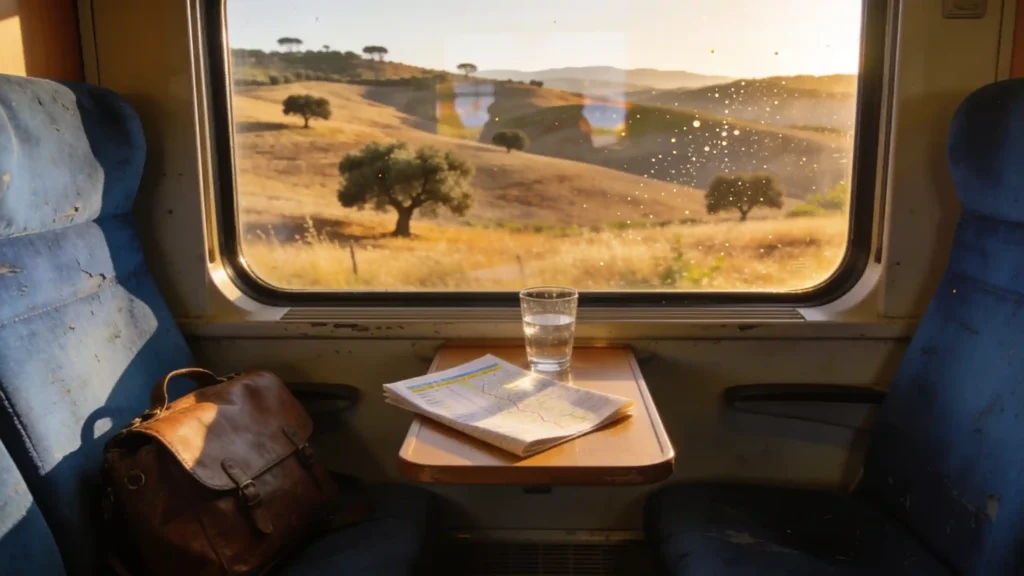
The simplest option is the direct train from Pisa Centrale: allow 1 h 30 to 2 h depending on the timetable. No parking to look for on arrival, which is already something.
A one-way ticket starts at around €17, and the price varies with the time and when you buy. Take the direct train, and keep the car for the inland villages.
From the airport, the drive is about 160 km and 2 h to Grosseto, excluding traffic, while the train requires a change:
It takes you to Pisa Centrale in about 5 minutes. You're on the right shuttle when it pulls into the station.
Choose a train with no change. You're on the right train when Grosseto is the final destination.
There's no direct train from Fiumicino to Grosseto.
First take the Leonardo Express to Roma Termini: 32 minutes, €14 for a single ticket, a departure every 15 minutes at peak times and every 30 minutes the rest of the time.
Then you have to change in Rome to continue to Grosseto. This often annoys travelers, but the connection almost always happens there. Build it into your travel time.
From Fiumicino terminal to Grosseto, allow at least 2 h 20 including the connection. Slower trains lengthen the journey.
The waiting time mostly changes the total: a quarter of an hour or half an hour.
Rome Ciampino mainly handles Ryanair flights. It has no station: a shuttle reaches Roma Termini in about 40 minutes, then it's the same train. By car, it's the fastest airport for the south: 2 h 02 to Orbetello, 2 h 18 to Pitigliano. For Saturnia, check the airport closest to the hot springs.
Choose Rome if you're sleeping in the southern Maremma and renting a car, if the flight is noticeably cheaper than Pisa's, or if you're also spending a few days in Lazio.
Compare both prices for the same dates and the same times, otherwise you're not comparing equivalent journeys.
On Sundays and public holidays, there are fewer trains, and almost no buses in the interior of the Maremma.
Train schedules to Grosseto also change with the season : check the timetable for the month of your trip.
Are you arriving on a weekend? Don't cut your connection close : a delay can leave you waiting a long time for the next train.
Before you leave, do these checks for buses and trains:
Add up your flight's arrival time, the time to exit the airport, and the duration of each leg.
Compare this total with the departure time of the last train or bus of the day to Grosseto: if your total exceeds that time, change your plan.
For up-to-date schedules, check the Maremma buses.
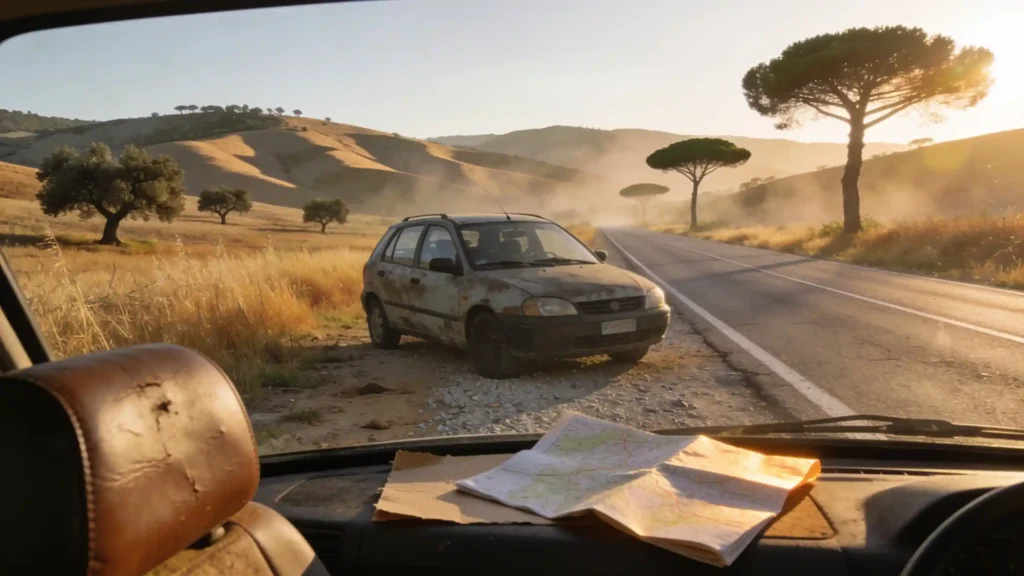
On the map, Grosseto does have its own airport, and that's the classic trap. Don't look for a flight landing there: for your stay, aim for a large airport, then reach the Maremma by train or car.
Florence-Peretola seems the closest, and that's where the trap begins.
Tram T2 reaches Santa Maria Novella station in 20 minutes, with a tram about every 5 minutes. The urban ticket costs €2 and lasts 90 minutes.
From the station, Grosseto is 2 h 22 by train at the fastest, and nearly 3 h on average. By train, the proximity advantage disappears there: only take Florence for Mount Amiata, or if your flight there is much cheaper.
By car from Florence airport, Grosseto is 150 km away, or about 2 h 15 without traffic: Pisa does better. The only exception is Mount Amiata: Arcidosso and Santa Fiora are 2 h 24 and 2 h 32 from Florence, versus 2 h 43 and 2 h 51 from Pisa.
To rent a car without unpleasant surprises, look at the car rental pitfalls in Italy before signing.
Grosseto is the hub of the province : buses and trains pass through, then you head to the coast or the interior. The center is best explored on foot, without a car.
For hikes, canoeing on the Ombrone, or horseback rides, look at the activities in the Maremma before leaving.
To reach the coast from Grosseto or Orbetello, you can take these bus lines:
Before you leave, check the bus to the final stop and plan the remaining journey. If the stop is far from your village or accommodation, a car remains the simplest option for those last kilometers.
For the right month, look at the Maremma calendar, month by month. To rent a car, compare cars for your dates.
For the northern Maremma and for trains, the answer is Pisa. For the south by car, it's Rome. For Mount Amiata, it's Florence.
Your next step: enter your city and village in the tool at the top of this page, then compare flights for your exact dates.
The Mount Amiata is worth the trip in winter if skiing is only part of your stay, but it is a risky bet if you come only for the slopes. At 1,738 meters, the massif receives snow when the weather allows it, without any guarantee of snow cover from one season to another. Even if a ski area appears on the map, that does not mean its lifts are running on the day of your visit. The Cantore chairlift, for example, experienced interruptions in early 2026; so it is better to check the actual situation rather than booking your weekend on the sole promise of skiing.
The right reflex is to check the status of the pole you are interested in the evening before, then check again the same morning, before leaving the valley. If the facilities are open, you can organize your day around skiing. If they are not running, the villages of the massif and the thermal baths can save the outing: visit Abbadia San Salvatore, Santa Fiora or Arcidosso, then head down to a hot spring suited to your route. This flexibility is what makes a winter stay in Amiata so appealing. If your itinerary is also hesitating between mountains and coast, this guide on the choice between the Val d’Orcia and the Maremma can help you build a more balanced trip.
When snow is lacking, the best plan is not to persist at altitude: head down to the villages, where winter remains interesting even without open slopes. In Abbadia San Salvatore, plan a walk in the medieval quarter and a visit to the Abbazia di San Salvatore or the Miniera di Abbadia, dedicated to mining history and cinnabar. The dark stone, narrow alleys, and mist give the town an atmosphere very different from the postcard landscapes of the Val d’Orcia. If you travel for Christmas, the Fiaccole della Notte di Natale are a special tradition of the village, but do not confuse them with an event offered all winter.
You can then head to Santa Fiora to see the clear basin linked to the source of the Fiora river, then finish with Arcidosso and its Castello Aldobrandesco, perched above the rooftops. Depending on the pace you want, choose a single village rather than spending the day in the car: a morning of sightseeing followed by a thermal afternoon works well. Bagni San Filippo is one option, but check access conditions and opening hours with the establishment you are targeting, as they vary by location. To extend your discovery of southern Tuscany, you can also consult this guide to the Etruscan heritage in the Maremma.
The beech forest of Mount Amiata is one of the most attractive settings of the massif in winter: its large gray trunks, bare branches, and the calm of the forest offer a real mountain experience, even far from the atmosphere of a resort. Snowshoes also have a practical advantage: unlike alpine skiing, they do not depend on the opening of a ski lift. However, they require a sufficient layer of snow. If only a little snow mixed with frozen mud and dead leaves remains, the walk may be uncomfortable and unrewarding.
Before booking, ask a local guide directly whether the snow cover actually allows snowshoeing on the planned day. Guided outings are offered by day or night, by reservation; for a night outing, also ask about the necessary equipment and plan for a headlamp. Trust the guide’s recent assessment rather than a photograph published several days earlier, because conditions can change quickly at altitude. After the walk, a break in a mountain hut with a hot chocolate or a simple meal is a good way to warm up. If the snow is too thin, keep your hiking boots and replace snowshoes with a village visit: the alleys of Santa Fiora or Abbadia San Salvatore remain an interesting alternative, without depending on the state of snowy trails.
The Mount Amiata ski area is spread across five poles: Vetta, Cantore, Macinaie, Marsiliana and Contessa. To prepare an outing, do not just check that a pole exists or that it is indicated on a map: ask whether its lifts are actually running on the planned day. Openings can vary, and the situation of one installation does not allow you to deduce that of the whole massif. The Cantore chairlift experienced interruptions in early 2026, which reminds us of the importance of a recent check before leaving the valley.
Check the status of the lifts at your chosen pole the evening before, then check a second time the same morning. If you are a beginner or traveling with children, ask about the options around Macinaie, where a ski school with qualified instructors is mentioned. If the lifts are not suitable, the cross-country ski trail linking Marsiliana and Macinaie can offer another way to enjoy the snow, provided conditions are appropriate. Avoid building your whole day around a single chairlift: instead, plan a village visit or a thermal bath as a backup. The five poles are not a guarantee that the entire area is running; it is the actual state of the facilities, confirmed just before departure, that should guide your schedule.
To combine mountains and hot water, first choose the area where you end your morning, then see which option falls most naturally on your route. Bagni San Filippo is a medieval thermal spa mentioned in the region and can suit after an outing in the surroundings of the massif. Other possibilities mentioned for a broader itinerary are Bagno Vignoni, Petriolo and Saturnia. There is no source to choose systematically: the point is mainly not to turn the end of the day into a long detour after a morning spent in the cold.
Access conditions and opening hours differ by location and can change. Before leaving, check directly the practical information of the spa or thermal establishment you choose, especially opening hours and access arrangements. Do not assume either that all sources have the same facilities or the same operation. The simplest sequence is to walk in the beech forest or do a snow activity in the morning if conditions allow, then head down to the thermal baths in the afternoon. If snow is absent, you can first visit Abbadia San Salvatore, Santa Fiora or Arcidosso. This formula makes the day pleasant even when the slopes remain closed: a village, a reasonable drive, and a moment in hot water rather than an uncertain wait at the foot of the lifts.
For a winter stay that must remain interesting even without snow, choose your accommodation based on the visits you want to make, rather than on a promise of skiing. Abbadia San Salvatore suits if you want to spend time in the medieval quarter, the abbey, and the Miniera di Abbadia. Santa Fiora is a quieter stop, marked by the basin of the Fiora spring and its mining history. Arcidosso, perched at 679 meters, offers another base to discover the Castello Aldobrandesco and the sloping streets. In all three cases, you can build a day of sightseeing without the opening of the lifts deciding your entire program.
To find authentic accommodation, check availability and booking conditions directly for the dates you are targeting, then verify the actual distance between the lodging, the villages you wish to visit, and your access to the massif. In winter, also ask about arrival and parking arrangements, especially if you plan to go up early to check snow conditions. Avoid booking a place just because it seems close to a slope: a change in weather can make that proximity less useful than a village where you can dine and stroll. Finally, keep a flexible day, with a morning at altitude and a backup plan in the towns or at the thermal baths. Amiata lends itself better to a stay that mixes forest, heritage, and hot water than to a trip entirely dependent on skiing.
Siena is the simplest choice for a first short trip to Tuscany…
This itinerary links Florence to Maremma in 7 days and 6 nights. It…
Volterra, the ancient Velathri, can be discovered in a day by linking Porta all'Arco, the…
The Cascate del Mulino in Saturnia are free, open 24 hours a day all year round and…
Frequently asked questions
Answers drawn from our travel times from the four airports.
For Maremma, it mainly depends on your village: go through Rome if you're aiming for the south by car, and through Pisa if you want to reach the north or the train. A direct flight to Grosseto isn't the simplest solution: the town is better reached by train from Pisa or Rome.
In practice, the Rome-Pisa line serves Grosseto, Orbetello and Follonica; from the station, you then take a bus or a car to reach your accommodation. For Capalbio, Orbetello or Pitigliano, Rome often remains shorter by car. For Castiglione della Pescaia or Massa Marittima, Pisa is more direct. For the Amiata, Florence is generally the closest.
The honest limit: the Maremma interior is poorly visited without a car, so plan a rental from the moment you arrive. Check the coming to Maremma page to compare the airports village by village, and the Maremma buses if you plan to go without a car on some trips.
Yes, but only if you accept limiting your ambitions: without a car, the Maremma interior is poorly visited. The Rome-Pisa train line only serves Grosseto, Orbetello and Follonica; beyond that, you need a bus or a car, and connections are rare. For villages like Pitigliano, Sorano or Saturnia, count on about two and a half hours of driving from Rome Fiumicino or Ciampino, and these distances can't be covered by public transport within a single day.
If you still want to travel without a car, choose a base on the rail axis (Grosseto, Orbetello or Follonica) and plan bus trips for excursions. Check the timetables on the page of our Maremma buses to verify schedules before organizing your trip. For the areas furthest from the coast, renting a car remains the simplest solution, as detailed in our guide rent a car.
For the Amiata, Arcidosso and Santa Fiora, Florence is the shortest airport: Arcidosso is 2 h 24 min from Florence, versus 2 h 54 min from Rome Ciampino and 3 h 04 min from Fiumicino. For Santa Fiora, Florence remains the best choice with a 2 h 32 min drive, versus 2 h 46 min from Ciampino.
These times assume a car: the Amiata is hard to cover by public transport, and the road from Florence winds through mountain bends, so allow extra time if you arrive at night. If your flight to Florence isn't convenient for you, Rome Ciampino remains a reasonable alternative for Santa Fiora, with only a few minutes' difference on this route.
Check the page on Maremma buses and the page on renting a car before booking, so you can confirm what is actually possible from the airport you choose.
For the northern coast, choose Pisa : it is the fastest airport for Castiglione della Pescaia (about a 2 h 02 min drive) and for Punta Ala (about 2 h 03 min). From Rome, plan on more than 3 hours, so Pisa's advantage is clear as soon as your arrival point is the northern coast.
The choice depends mostly on how you plan to get around. If you rent a car at the airport, Pisa spares you from crossing all of Maremma from the south and cuts the time spent on the road. If you prefer the train, Pisa is still relevant: the Rome–Pisa line serves Grosseto, then a bus or taxi takes over to the coast. Also see the car rental before booking, since the final leg without a vehicle is not very practical.
One limit to keep in mind: these durations are estimated driving times, not guarantees, and they vary with traffic, especially in high season and on weekends. Check the times of your flights and connections before you leave.
 Français Français
 Italiano
 English
 Polski
 Português do Brasil
 Nederlands
 Español
 Deutsch