









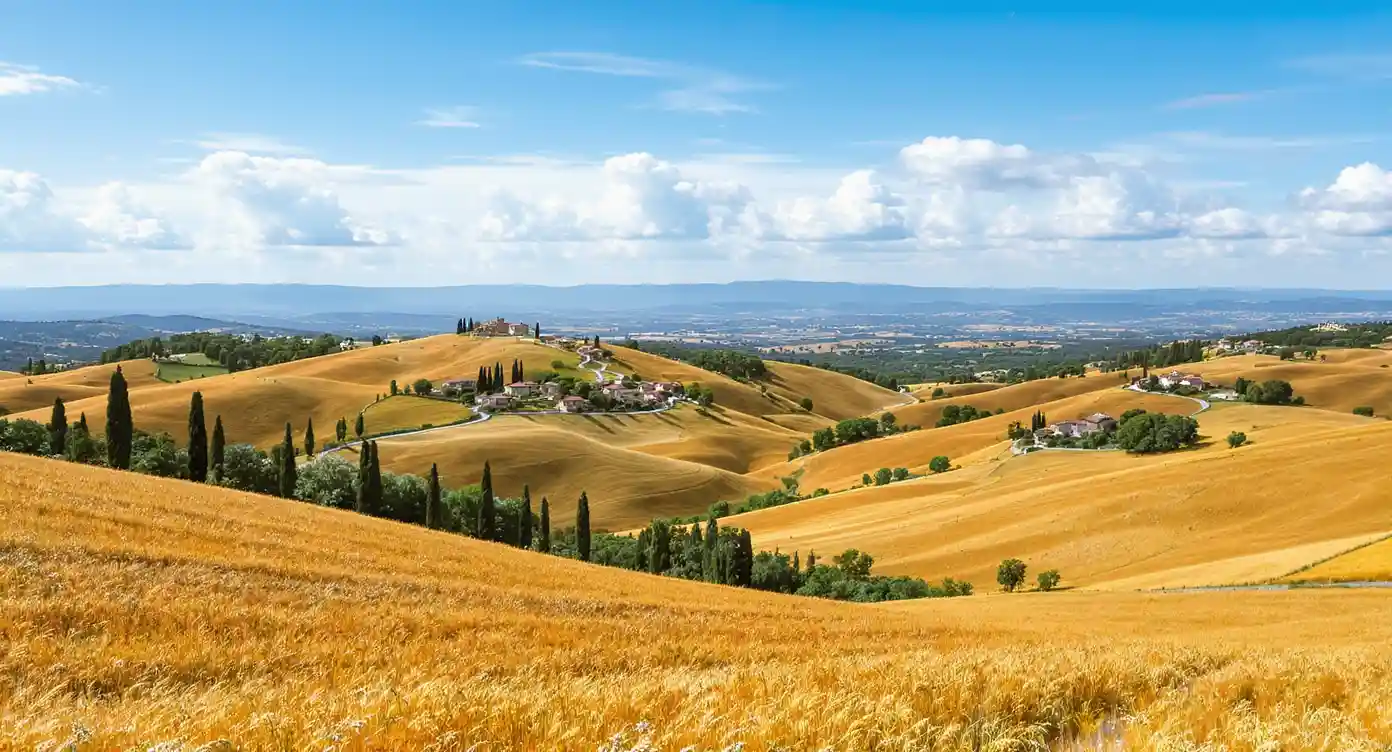
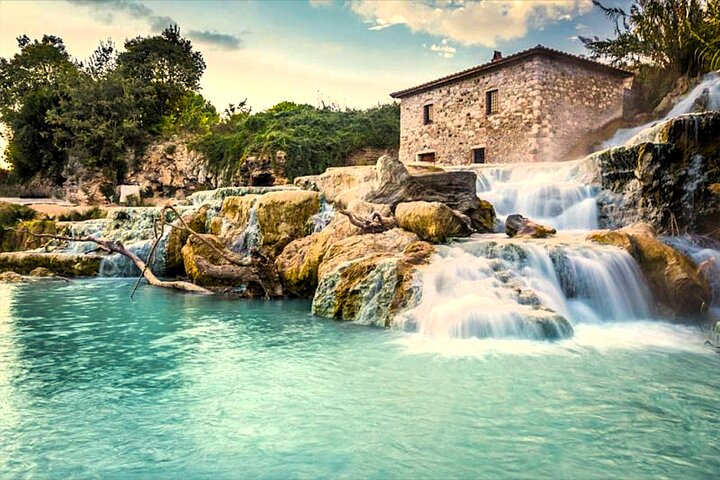
The Cascate del Mulino of Saturnia remain free to access, with water around 37 °C. At Bagno Vignoni, however, the historic basin is not open for bathing. Val d’Orcia, a UNESCO World Heritage Site since 2004, appeals with its hills and villages such as Pienza. For a less visited Tuscany, I recommend Maremma instead, between tufa villages and the Parco della Maremma.
At the Cascate del Mulino in Saturnia, you'll find outdoor baths, free to access, at around 37 °C. This kind of detail sums up Maremma well: strong experiences, no ticketing. Val d’Orcia, for its part, focuses mainly on its landscapes and heritage.
In Val d’Orcia, you drive through cultivated hills, cypresses and villages such as Pienza, Montalcino or San Quirico d’Orcia, with the Brunello of Montalcino at the table. Maremma, meanwhile, mixes wild coast, tufa villages such as Pitigliano, Sovana and Sorano, and the Maremma Park. Le Morellino is the local wine.
My verdict: choose Maremma if you want to escape the crowds and a less visited Tuscany, without thinking it is deserted everywhere. Choose Val d’Orcia if iconic landscapes and heritage come before everything else.
Doing both in one week is possible, provided you narrow the itinerary to a few chosen stops. Wanting to see everything is the classic trap: you would spend more time behind the wheel than enjoying the places.
The verdict in three lines: which southern Tuscany suits you?
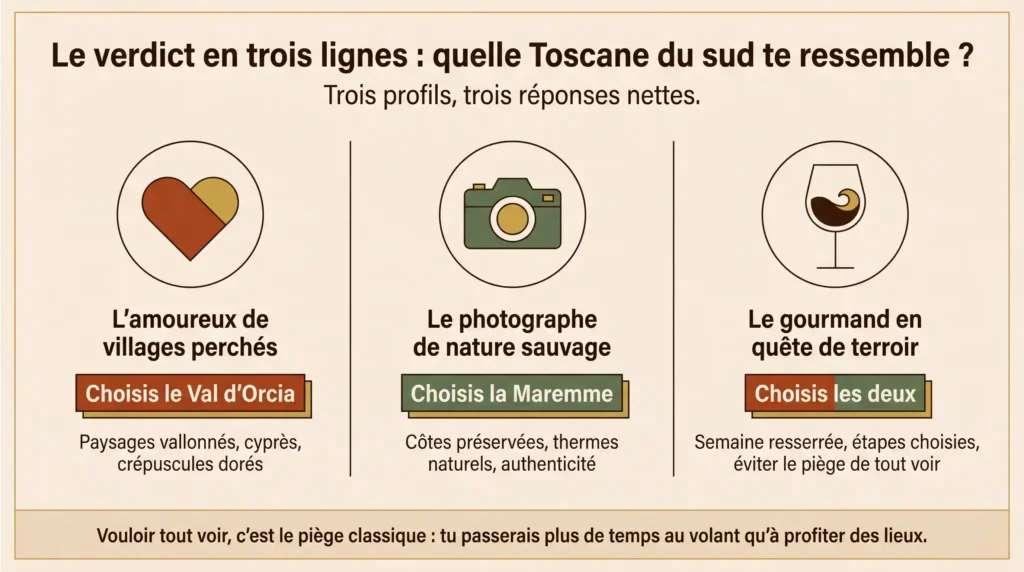
It depends mostly on the kind of trip you want to have. Three profiles, three clear answers.
Three profiles, three clear answers
- Heritage and iconic landscapes : go towards the Val d'Orcia. Cultivated hills, cypress trees, villages: Pienza, Montalcino and San Quirico d’Orcia will serve as your landmarks.
- A less crowded Tuscany : head toward Maremma. The villages of tuff (Pitigliano, Sovana and Sorano) will guide you, just like the Maremma Park. And the coastline comes as a bonus.
- Outdoor thermal bathing : head toward the Cascate del Mulino in Saturnia, in Maremma, where you bathe in the middle of nature. In Bagno Vignoni, the historic basin is off-limits for swimming.
Want to combine both regions? Plan for one real stop in each, rather than rushing through everything.
Hills and cypresses or wild coast and tufa: two landscapes, two rhythms
Val d’Orcia: Tuscany of scenic routes
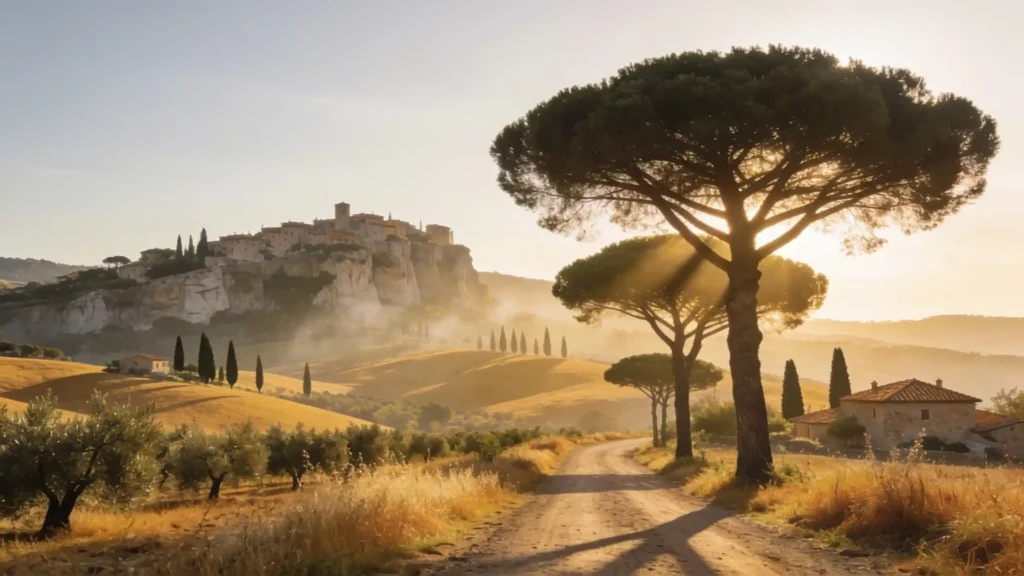
The Val d’Orcia, in the south of the province of Siena, unfolds its cultivated hills, fields, vineyards and cypress trees along scenic roads. The colors change with the seasons, and it is this slow shifting that gives it its charm. Listed as a UNESCO World Heritage Site since 2004, it remains the most obvious choice for anyone who wants to see the most recognizable Tuscan landscape.
Maremma: choosing the less visited south
Maremma moves to a different rhythm. Here you find a wild coastline, tuff villages such as Sorano or Pitigliano, and natural areas inland. With the Maremma Park, nature can take up a good part of your your stay, without a tight schedule.
If you are looking for a less crowded Tuscany, I recommend Maremma. Val d’Orcia has the cypress trees and the lookout points; Maremma, for its part, offers above all variety.
Villages and heritage: Renaissance city or tufa hamlets?
Val d’Orcia, between heritage and hilltop villages
The Val d’Orcia tells the story of a Tuscany built step by step. Pienza is the ideal city commissioned by Pope Pius II, and its heritage is listed as aUNESCO. San Quirico d'Orcia is a fortified medieval village, set along the Via Francigena. It offers the Horti Leonini and its Romanesque collegiate church. Montalcino combines its medieval village with Brunello di Montalcino.
Montepulciano lies on the edge of the Val d’Orcia, bordering the Valdichiana. It is a borderline case, not a decisive argument for the Val d’Orcia.
Maremma, between tufa villages and coastline
Maremma offers a different heritage: Pitigliano, Sovana and Sorano are built into tufa, the volcanic rock that carves their streets and cliffs. You don’t walk through a city planned on a grid, but through a village carved into the stone.

Pitigliano
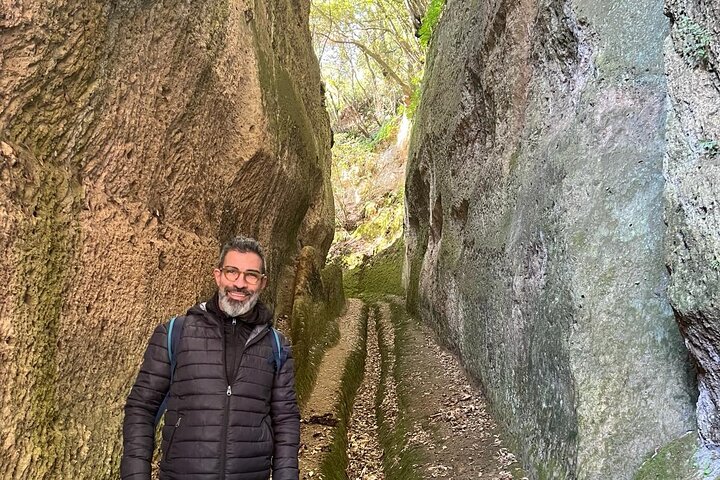
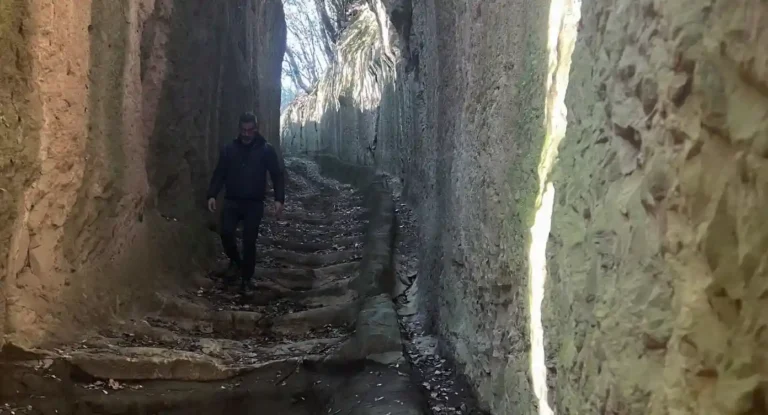
Tuff village clinging to its cliff, with a Jewish quarter, a 1598 synagogue, the Palazzo Orsini and Vie Cave carved by the Etruscans

Tosco Make sure to stop at the viewpoint on the road when arriving from Manciano at sunset: seeing this village carved into the tuff suddenly glow is one of the most breathtaking panoramas in all of Tuscany!
The coastline follows a different logic. The Grosseto area, Piombino and theisland of Elba offshore are beach stops, not immediate neighbors of the tufa villages. Count the travel times before combining them in one trip.
Spas: the Bagno Vignoni basin versus the free Saturnia waterfalls
Val d’Orcia: Bagno Vignoni, to admire rather than to bathe in
Bagno Vignoni remains a thermal landmark of the Val d’Orcia, with its large stone basin at the heart of the village. However, the historic basin is not accessible for swimming. Come for the scenery and thermal history, not to swim.
Maremma: Saturnia for outdoor baths

Saturnia
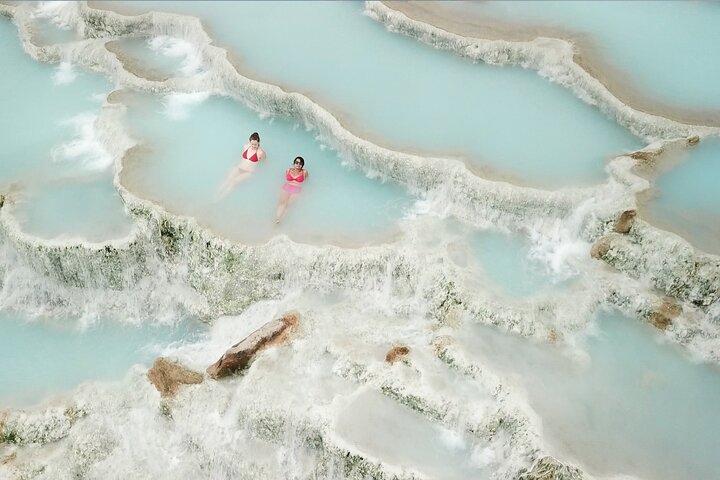
A free thermal bath at 37.5 °C in travertine pools shaped by the Gorello stream, accessible 24/7 and free of charge all year round

Tosco My tip: come at dawn or even in the middle of the night with a flashlight to splash around under the stars at 37.5°C without the daytime crowds!
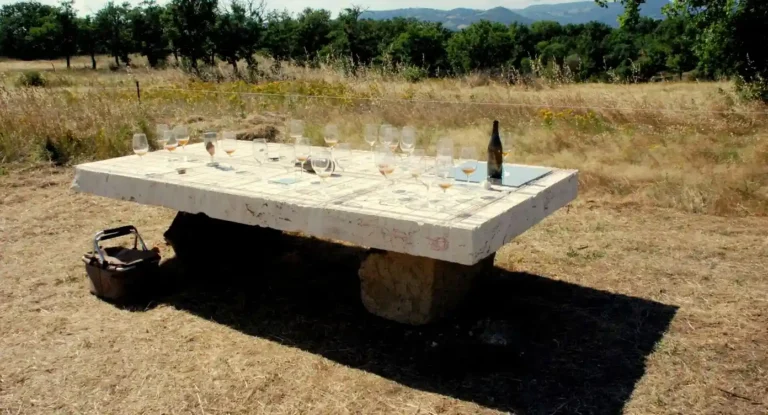
The Cascate del Mulino offer open-air baths in water at around 37 °C. For bathing outdoors without spending much, it is hard to beat.
Parking is another matter: check the current rate before you leave, rather than assuming it is free or paid.
Want to swim? Saturnia. Prefer a thermal village to visit without touching the water? Bagno Vignoni.
Our picks · Saturnia
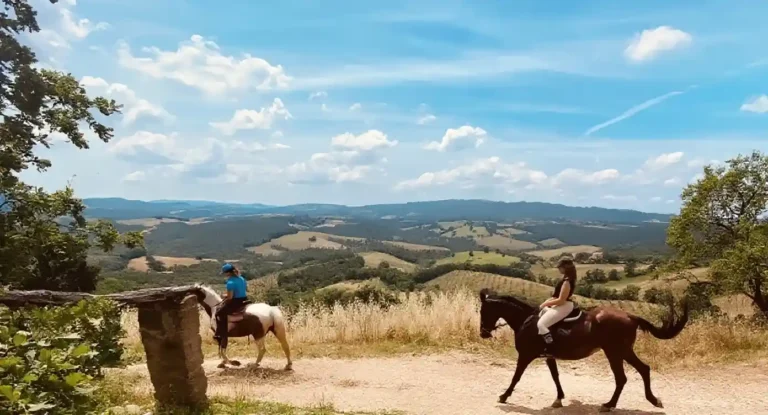
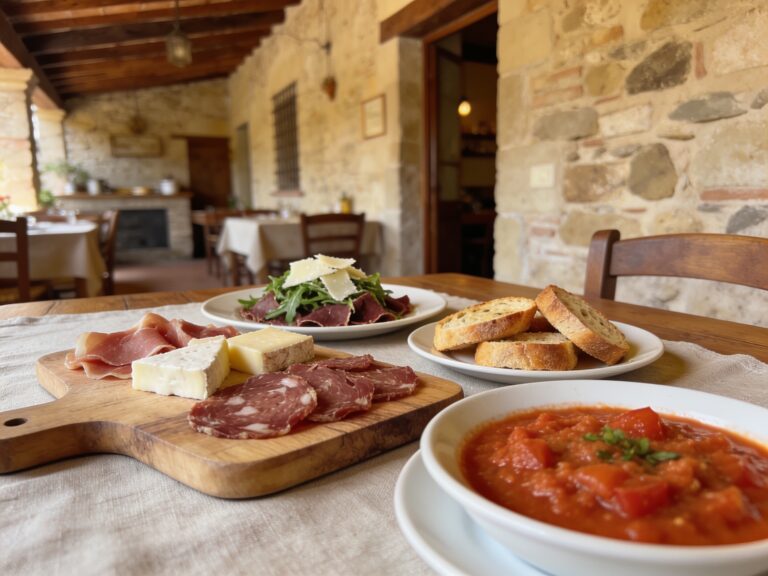
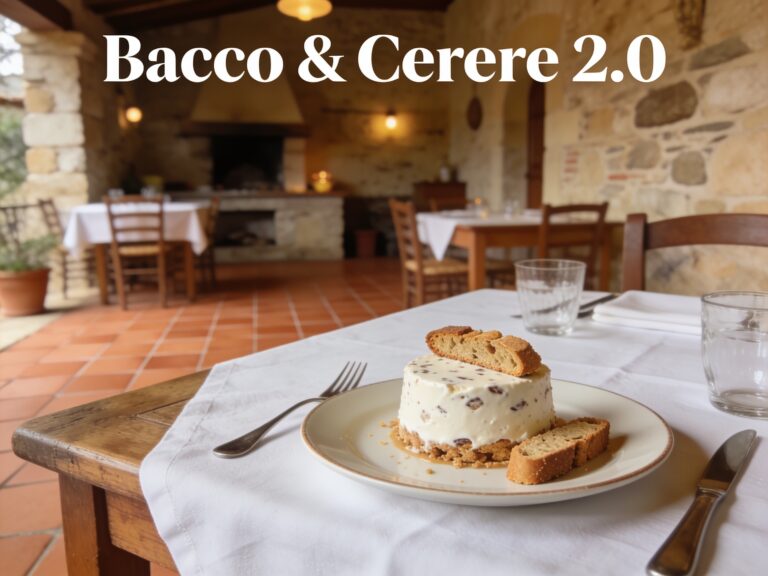
Our favorite spots around Saturnia
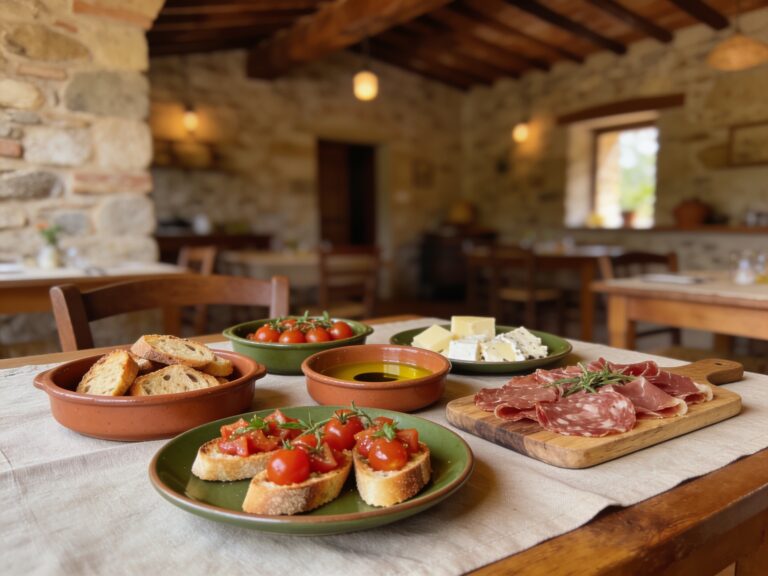
Brunello or Morellino: two wine identities, not the same trip
On the Val d’Orcia side: Brunello as the benchmark of Montalcino
In Montalcino, you almost always order the Brunello di Montalcino first. It sums up the village’s terroir and structures the tastings, often among the hills seen on every Val d’Orcia postcard.
Southern Tuscany is far more than this wine. Yet it is this wine that gives the Val d’Orcia part of your stay its most immediate identity.
On the Maremma side: Morellino in the face-off

Morellino di scansano DOCG
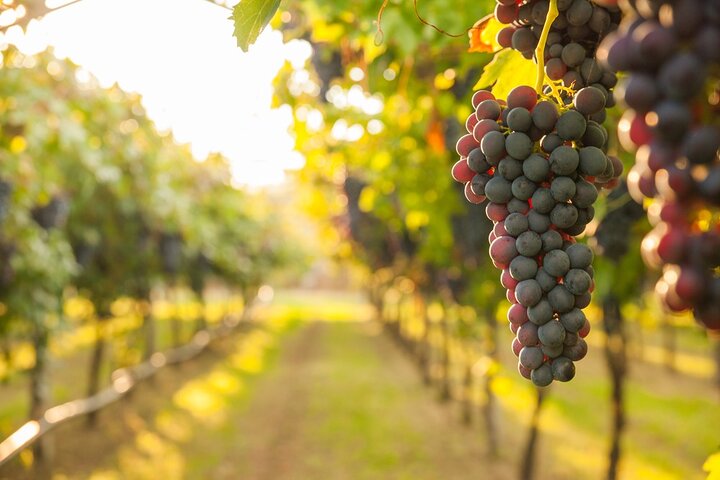
Morellino di Scansano is the red DOCG of Maremma, a Sangiovese grown on about 1500 hectares around Scansano, a village located at 500 meters above sea level
Tosco Forget the severity of a Chianti: here, the sea breezes fill the Sangiovese with sun, producing a much rounder, fruitier red, perfect to enjoy young with an aged pecorino!
Across the way, the Morellino is Maremma’s wine landmark. It tells the story of a less solemn region: vineyards closer to everyday life, villages scattered between hills and coastline.
It all comes down to the atmosphere, really. Choose Brunello if your stop revolves around Montalcino; pick Morellino if your stay should follow Maremma’s rhythm.
Wine tastings · Montalcino
Our favorite tastings around Montalcino
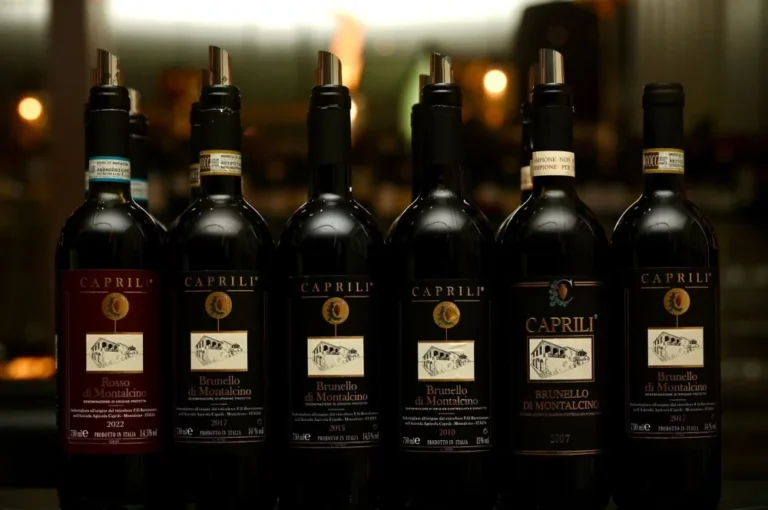
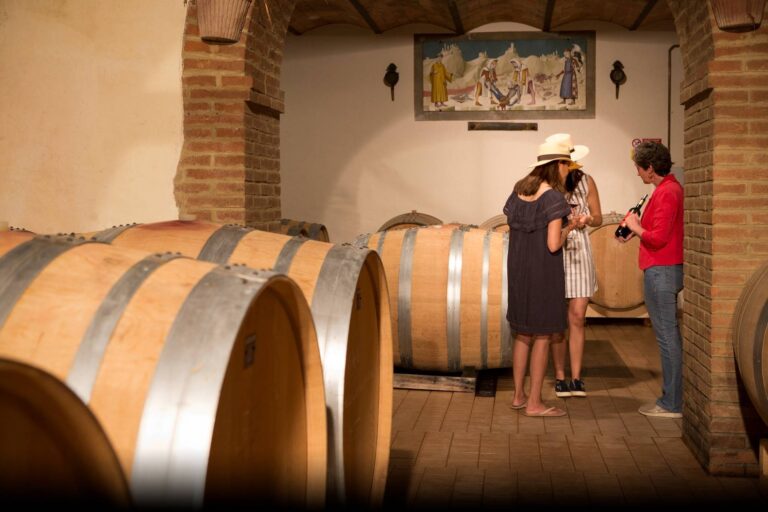
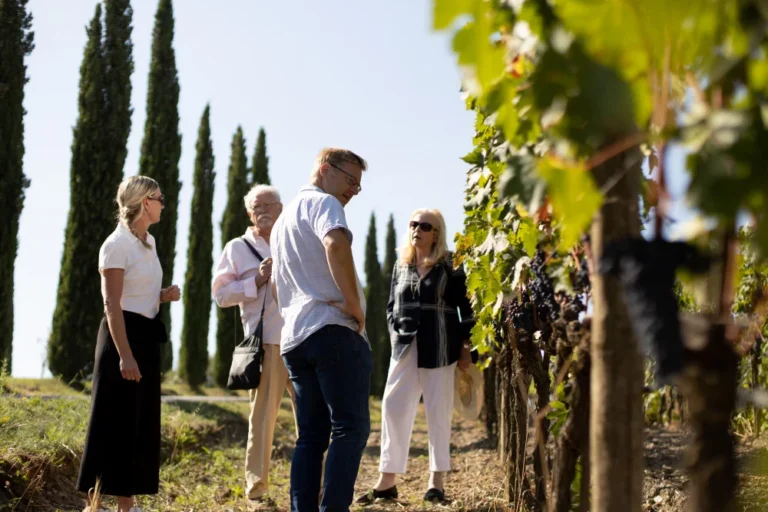
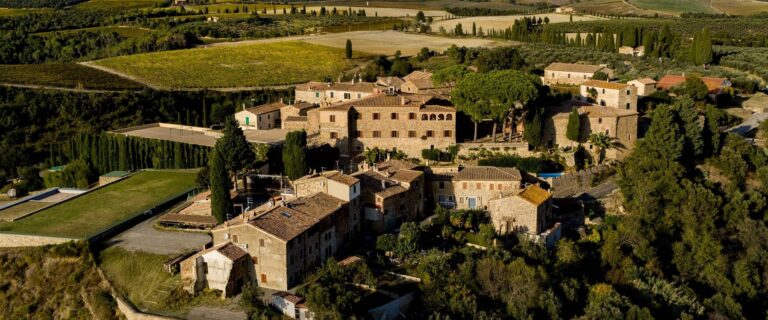
Guided tour of the cellar and wine tasting at the Tenuta Corte Pavone in Montalcino
Excessive alcohol consumption is dangerous for health, drink in moderation.
Crowds, season and accommodation: Maremma wins on calm, not necessarily on price
Less visited does not automatically mean cheaper
If you want above all to avoid the crowds, take the Maremma: it is the less visited of the two regions. Val d’Orcia nonetheless remains a landscape apart, where the fields change color with the seasons.
A quieter atmosphere does not mean a lower budget. Calm sets no price, so choose your accommodation according to the experience you want.
Examples of accommodation in Maremma, with no promise of a lower rate
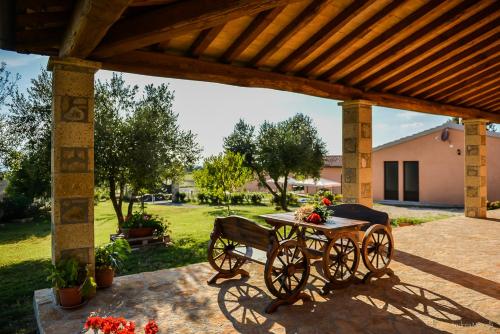
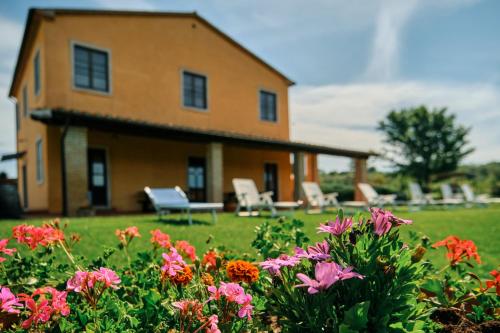
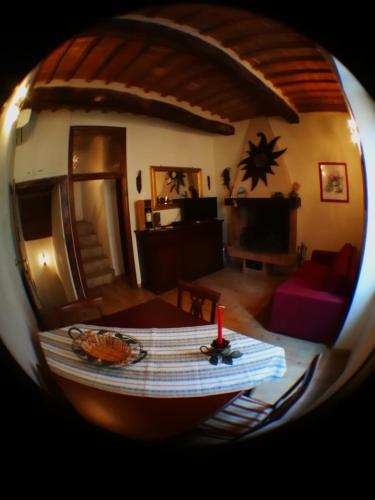
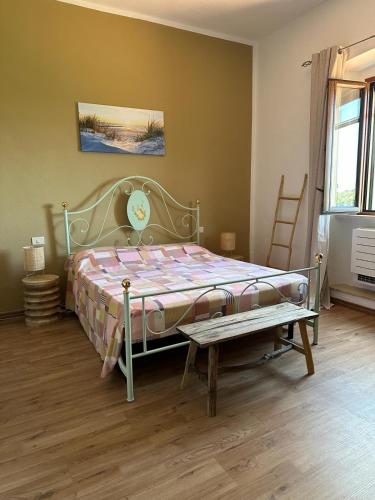
À Pitigliano, Casa del Ghetto occupies the historic Jewish quarter. At Manciano, La Svolta – Acqua is a family agriturismo, away from the hustle and bustle. Casale Oleo, for its part, is a renovated agriturismo in the middle of the countryside.
These are different types of stays, not price ranges.
Car and travel: Val d’Orcia requires planning your journeys in advance
Val d’Orcia, to explore by car
In the valley, it is hard to do without a car: it is almost essential. The train does not serve Val d’Orcia directly. You have to get off at Buonconvento , or Chiusi-Chianciano, then take the bus, and each leg is made longer as a result.
If you want to link Pienza, Montalcino and San Quirico d’Orcia at your own pace, and stop on the scenic roads between two villages, take a vehicle. Buses are poorly suited to exploring the valley as your whim takes you.
Maremma, a logistics point to check before the final comparison
In Maremma, trains and buses reach some coastal destinations, around Grosseto. But this does not necessarily cover all the inland villages.
Are you combining the two regions? Check each connection for your exact dates. Timetables, transfers and service conditions all vary from one town to another.
Recheck the timetables the day before each trip. A connection noted on an itinerary is only valid on the day you take it.

Choosing by profile — and combining both in one week without rushing
The verdict by type of traveler
If your first stay should above all offer landscapes and heritage, choose Val d'Orcia, with its hills, cypresses and villages of Pienza, San Quirico d’Orcia and Montalcino. Want a less crowded Tuscany? Take the Maremma : the tufa villages, Pitigliano, Sovana and Sorano, and the Maremma Park offer a natural stop at a calmer pace.
For swimming, head to the Cascate del Mulino at Saturnia: the water hovers around 37 °C, in the open air, and the stop easily fits into a day. Check parking separately. In Bagno Vignoni, on the other hand, the historic basin remains closed to swimming.
Are you traveling as a couple, with family, for nature or on a tight budget? Start from your priority, not from a region’s reputation. A cheaper option? Compare it against your dates before counting on it.
One week across two regions: spreading the stops before hitting the road
Yes, one week is enough for both regions, but not without preparation. Plan two bases, one for each part, so you don’t spend your days behind the wheel.
Val d’Orcia part: Pienza, San Quirico d’Orcia or Montalcino. Maremma part: Pitigliano, Sovana, Sorano, Saturnia or the Maremma Park, depending on your priorities.
Verdict: choose Maremma if you want to avoid the most crowded itineraries, and Val d’Orcia for its hill landscapes and heritage. Before setting the number of nights per stop, check the travel times for your exact dates.
Maremma or Val d’Orcia: choose based on the Tuscany you really want to see
Looking for a less visited Tuscany, with tufa villages like Pitigliano and Sorano, and landscapes that change from one valley to the next? Take Maremma. If you mainly want the hills, cypresses and heritage villages? Val d’Orcia is made for you.
Swimming, too, differs from one side to the other. The natural thermal baths of Saturnia are free to access. The historic basin of Bagno Vignoni, on the other hand, is more of a paid, supervised access. If your budget counts this expense, decide it right away.
One week for both regions? Don’t spend your time on the road. Keep two or three stops, for example one base in Val d’Orcia and another in Maremma, and stay long enough in each to really enjoy them. A slower itinerary will always be more pleasant than a rushed full tour.
If you dream of rolling hills, cypress trees and panoramic roads often associated with Tuscany, choose the Val d'Orcia. This region in the south of the province of Siena is particularly suited to a first stay devoted to landscapes and heritage. You can move between Pienza, San Quirico d'Orcia and Montalcino, stopping in villages and viewpoints rather than racking up kilometers. The Val d’Orcia has been a UNESCO World Heritage site since 2004, and its scenery changes with the seasons: the countryside does not look the same in spring, summer, or after the harvests.
The Maremma responds to a different desire. It combines tufa villages like Pitigliano, Sovana and Sorano, natural areas and a wilder coastline. It suits you well if you prefer variety in atmospheres and seek a less crowded Tuscany, even if that doesn’t mean every place will be deserted. To decide, ask yourself whether you want first to photograph hills and visit heritage villages, or alternate stone towns, nature and coast. In both cases, plan for a car to explore at your own pace and check travel times before booking your nights. If you only have a short stay, it’s better to choose one region and enjoy a few stages than to try to see everything in a rush.
Yes, the Cascate del Mulino, near Saturnia in the Maremma, are described as open-air baths with free access. The water is around 37 °C, which makes swimming possible all year round according to the article’s information. The site is advertised as open 24 hours a day, but that doesn’t mean the visit conditions, crowds, or services around the pools are the same at all hours. For a quieter experience, avoid if possible the busiest periods and allow time to change and enjoy without turning the stop into a quick pass.
The practical point to anticipate is parking: don’t assume it’s free or paid, as the rate can change. Check the applicable terms for your visit date before hitting the road. Also remember to bring a towel, dry clothes, and suitable shoes for walking on wet, uneven ground. Free access to the pools doesn’t mean it’s a thermal establishment with changing rooms or guaranteed services. The Cascate del Mulino are a good stop if you’re looking for free natural hot springs in Tuscany, but they don’t replace a visit to the region’s villages. From Saturnia, organize the day according to your wishes: swimming, exploring the tufa towns, or a stop in the Maremma countryside. However, don’t confuse these pools with Bagno Vignoni, which is not open for swimming.
Yes, a week can be enough to discover both the Val d'Orcia and part of the Maremma, provided you select a few stages. The mistake would be to try to visit every village, do the coast, cover the Maremma Park, and add all the thermal stops in the same itinerary. Distances and roads take time, and an overpacked program easily turns the stay into a series of trips. Instead, plan two bases, one for each region, and keep enough nights in each to explore the surroundings without repacking your bags every day.
On the Val d’Orcia side, choose a drop-off point that allows you to visit Pienza, San Quirico d'Orcia or Montalcino according to your priorities. For the Maremma, you can organize another stage around Pitigliano, the neighboring villages of Sovana and Sorano, or Saturnia if open-air baths are important to you. It’s better to keep two or three main objectives per region than to try to fit everything in. Before booking, calculate travel times between your accommodations and planned visits for your exact dates. A week is therefore realistic for a well-constructed overview, not for an exhaustive exploration of southern Tuscany. By reducing the number of stages and choosing well-located accommodations, you’ll enjoy the villages, landscapes and thermal breaks more.
To explore the Val d'Orcia freely, a car is almost essential. The train doesn’t serve the valley directly: the article says you need to reach Buonconvento or Chiusi-Chianciano, then continue by bus. Connections can lengthen journeys and make a day with several villages more difficult, especially if you want to stop on panoramic roads. Without a car, you can organize a targeted visit, but avoid relying on public transport to easily improvise a route between Pienza, Montalcino and San Quirico d'Orcia.
In the Maremma, trains and buses serve certain destinations, especially around Grosseto, but these links don’t necessarily cover inland villages like Pitigliano, Sovana or Sorano. If you travel without a vehicle, it’s often more comfortable to choose a single region, take accommodation near a useful link and check in advance how to reach each visit. Schedules, connections and service can vary by municipality and date; check routes for your travel days, then again the day before. A rental car becomes especially interesting if you want to combine several distant villages or reach the Cascate del Mulino at Saturnia. If you’d rather not drive, reduce the number of stages and build your stay around the actually available transport rather than a theoretical itinerary.
The right choice mainly depends on the pace you want to give your stay. In Pitigliano, sleeping in the historic center allows you to enjoy the tufa village on foot, its alleys and its atmosphere after the day’s visitors leave. The article cites Casa del Ghetto, located in the historic Jewish quarter, as an example of city accommodation. This option may suit you if you want to spend time on heritage and then head to Sovana or Sorano. However, check access to your lodging, parking options, and the distance between the parking lot and your address, especially if you travel with luggage.
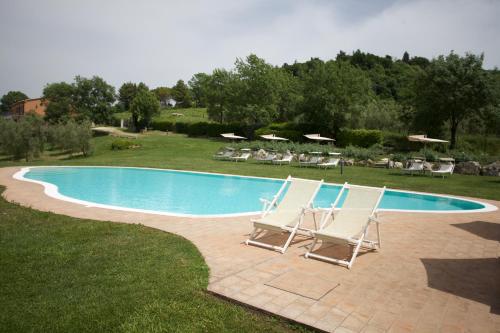
A farm stay in the Maremma offers a different atmosphere: more countryside, a calmer stay and often a base where you take the time to settle in. Among the mentioned examples are La Svolta – Acqua, a family agriturismo away from the hustle and bustle, near Manciano, and Casale Oleo, a renovated agriturismo in the open countryside. These are distinct experiences, not a guarantee of lower prices. So don’t choose the Maremma just by assuming it will be cheaper than the Val d’Orcia: compare rates and availability for your dates, as well as any additional fees and cancellation conditions. For both types of lodging, also look at driving time to planned visits. An authentic accommodation is especially successful when it matches your program, your need for calm, and your way of getting around.
If your itinerary is centered on Montalcino et la Val d'Orcia, Brunello di Montalcino is the most obvious wine reference. It naturally matches a day devoted to the medieval village, hills and valley landscapes. You can organize your visit around Montalcino and plan a tasting as a full-fledged stage, rather than adding it between two long trips. If you’re driving, think about adapting your program: it’s better to plan a tasting without getting back behind the wheel afterwards, or choose another transport solution. Here, wine accompanies the identity of the stay, but it doesn’t alone summarize the diversity of southern Tuscany.
In the Maremma, Morellino is the wine that serves as a reference in the article. It suits a trip where you alternate tufa villages, countryside and, depending on your route, coast or natural areas. To choose between the two, ask yourself which region you want to explore rather than looking for a winner: Brunello for a stop oriented toward Montalcino and Val d’Orcia heritage, Morellino to accompany a discovery of the Maremma. If you want to taste both, plan separate stops and check in advance the visiting and tasting options for your dates. Opening hours and reception arrangements vary from one establishment to another. Finally, don’t try to combine a tasting with too dense a route: in southern Tuscany, taking time to lunch and enjoy the landscape is often as much a part of the trip as visiting villages.
Around this article




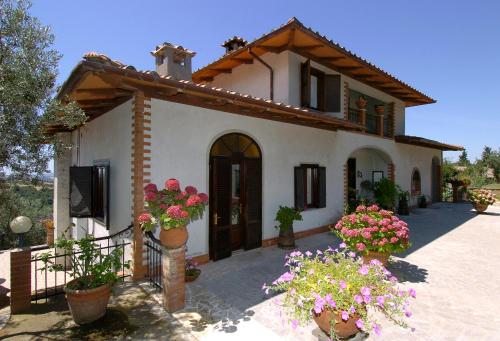
Live map & prices
Where to stay around Pitigliano?
Compare accommodations and their prices on the map, then book in just a few clicks.
Is the map not displaying? See accommodations on Stay22
Map and prices provided by Stay22: Toscane Cachée may receive a commission on bookings.
Cars · live prices
Your rental car from Grosseto airport
No rental agency sets up in the villages: the closest agencies to Pitigliano are in Grosseto. Here are the best current deals, compared and rated.
Searching for available cars…
See all cars and choose my dates
Booking and payment through Discovercars: the link earns us a commission, without changing your price.
Around Pitigliano
You will also like
What to do in Maremma in December 2026: Christmas, sagre and winter thermal baths
In December, the Cascate del Mulino at Saturnia remain free and accessible all year round,…
Self-drive tour of Tuscany in 2026: 7-day car itinerary, from Florence to the Maremma
This itinerary links Florence to Maremma in 7 days and 6 nights. It…
Red wines of Maremma: the power of Super Tuscans
What you need to remember: the province of Grosseto breaks the codes with…

Thermal baths in Tuscany: the complete guide to hot springs (and why Maremma dominates)
Discover the hot springs of Maremma: bathe at 37°C in Saturnia or Petriolo. Enjoy…
