
Natural Park
The place
Le vignoble de Montecarlo vaut le détour pour ses collines et ses domaines familiaux, mais sans adresse, visite ni dégustation documentées, prépare ton étape toi-même.
👥 Who it's for: Wine lovers and fans of medieval villages looking for a peaceful escape near Lucca.
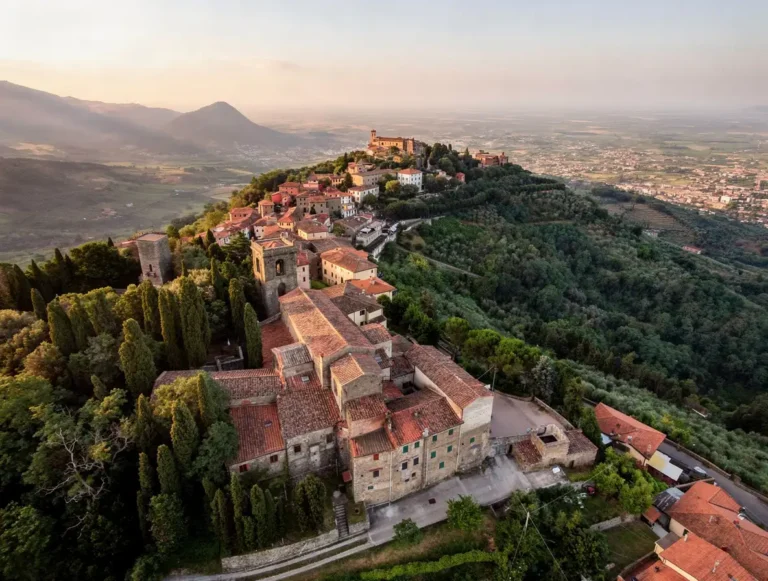
In Montecarlo, in the province of Lucca, rows of vines wind across gentle hills between olive groves, woods and small country roads. The setting lacks the theatrical grandeur of Chianti: it is more understated, closer to rural life. People come here to take their time, push open the door of a family estate and discover wines that tell the story of a corner of Tuscany still largely untouched by the classic tourist circuits.
The medieval village stands on the hill of Cerruglio, at 163 meters above sea level, above the Lucca plain. From its ancient gates, the gaze glides over the vines and neighboring hills. Montecarlo is near Montecatini, but do not confuse it with the principality of Monaco: its name comes from Mons Caroli, the «mountain of Charles», in reference to Charles IV, who founded the town after freeing Lucca from Pisan rule. To extend your discovery of the area, the hilltop village of Montecatini Alto is another stop worth considering.
The local winemaking tradition is ancient. Montecarlo wine was already appreciated in the early 15th century: Pope Gregory XII praised it at the time. The region now has its own appellation, the Montecarlo DOC. The white received this recognition in 1969, followed by the red in 1985. An ancient road between Lucca and Florence bore the name Via Vinaria, a reminder of the importance of the wine trade in the region.
The DOC white is a blend that may combine Tuscan Trebbiano, Sémillon, Pinot gris, Vermentino, Sauvignon or Roussanne. The red relies mainly on Sangiovese, complemented in particular by Canaiolo and other authorized grape varieties. At the table, the white pairs readily with fish, appetizers and the region's soups; the red is better suited to roasted meats, game and heartier dishes. Enthusiasts who wish to explore other terroirs can browse our section dedicated to wines and vineyards of Tuscany.
It is not a single vineyard with a centralized welcome, but a collection of estates scattered across the countryside. Producers on the wine route include Fattoria del Teso, Fattoria La Torre, Fattoria del Buonamico and Azienda Agricola Enzo Carmignani. Visits depend on the availability of each estate: call or write before setting off, especially if you would like to visit a cellar or take part in a guided tasting.
Fattoria del Teso, for example, offers visits and tastings by reservation, from Monday to Sunday, at 11 a.m., 2 p.m. or 5 p.m. It is located at Via della Poltroniera, in Montecarlo, and lists +39 392 6065139 for reservations. These hours apply to this estate, not to all the cellars in the area. Check them directly before your visit, as the conditions for visits may change.
Once at the estate, the experience is not limited to the glass set on the table. Depending on the option chosen, you can explore the vines or the cellar, taste several cuvées and pair them with olive oil, bruschette or local products. Take the time to ask how the grape varieties go into the composition of the wines and which pairings the producer recommends. It is often through these exchanges that you best understand what distinguishes the white from the red of Montecarlo.
Also keep some time to stroll around the village: its medieval ramparts, its sloping alleys and the views from Porta a Lucca or Porta Nuova make for a lovely end to the day. If hilltop villages and old stones appeal to you, you will find more ideas in our guide to most beautiful villages in Italy.
The end of spring and the beginning of autumn offer particularly pleasant light on the hillsides. During the grape harvest, the landscape takes on a different presence, even if the calendar varies from year to year. Since the cellars do not have uniform opening hours, it is best not to count on a spontaneous visit. By car, it is easier to organize a stop at several estates, but plan for a driver who does not taste: the estates are spread around the village and are not concentrated in the center.
To discover several cellars without driving from one estate to another, look for the event Via Vinaria. Created in spring 2000, it opens the participating cellars and offers free shuttles called Wine-Bus. The 2026 edition took place on May 16 and 17, from 2 p.m. to 7 p.m. ; these dates have passed. The shuttles are organized for the event and are not a permanent service. Check the program of the next edition before planning your stay.
Choose a single cellar and give it the time it deserves, rather than multiplying stops. Ask to compare a DOC white and a DOC red, then let the producer guide you toward a pairing with the flavors of the territory. The pleasure of Montecarlo lies in this human scale: the hills are close, the village remains within sight, and the wine is better understood when you taste it where it grows.
Evaluation criteria
Is the map not displaying? See accommodations on Stay22
Map and prices provided by Stay22: Toscane Cachée may receive a commission on bookings.
 Français Français
 Italiano
 English
 Polski
 Português do Brasil
 Nederlands
 Español
 Deutsch