Home › FAQ › Culture & heritage › History
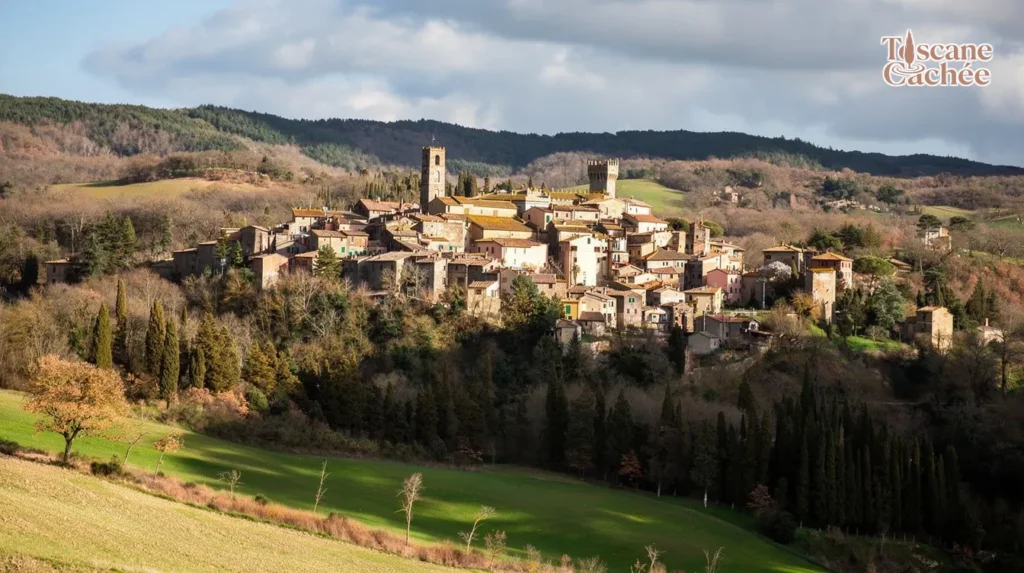
The history of the baths of San Casciano dei Bagni begins at least in the IIIe century BCE : the Etruscans had laid out a sacred space around the spring of the Bagno Grande. People came there to bathe, but also to seek healing and honor the deities associated with the waters. The Romans later enlarged and reorganized the sanctuary, which remained active for several centuries.
The excavations revealed offerings deposited in the basin: coins, ex-votos and statues, with inscriptions in Etruscan and Latin. In 2022, the archaeologists notably announced the discovery of more than twenty bronzes, preserved in the hot water and mud. These objects bear witness to the gradual transition between the Etruscan and Roman cultures; they do not prove that all visitors came solely to be healed.
The use of the springs continued long after Antiquity. After an earthquake in 1575, a pool and a small portico were built on the remains; in 1607, Grand Duke Ferdinand I had the Portico Grandebuilt. Today, the municipality has 42 thermal springs, around 40 °C. The archaeological site of the Bagno Grande and the current baths therefore tell of two intertwined uses: ancient worship and thermalism.
 Article
 Article
 Article
 Place sheet
 Français Français
 Italiano
 English
 Polski
 Português do Brasil
 Nederlands
 Español
 Deutsch

