Museum
The place
Vas-y pour la tombe à édicule et son fronton figuré, puis enchaîne sur les Vie Cave de Sovana pour compléter la visite.
👥 Who it's for: History buffs, archaeology enthusiasts and nature lovers in search of authentic discoveries.
Ah, Etruria! That name alone evokes mysteries, civilizations buried beneath the Tuscan soil. And what if I told you that there is a corner of this secret Tuscany where time has stood still, where every stone, every hollow in the rock, tells a story more than two millennia old? Far from the crowds of Florence or Siena, today I am taking you to Sovana, in the heart of the Maremma, for an intimate encounter with the Tomba della Sirena.
Imagine for a moment: the scent of damp earth, the soft light filtered through the canopy, the silence broken only by the distant song of a bird. It is in this enchanting setting that stands, or rather that is carved, this archaeological marvel. It is not a simple tomb, it is a gateway to the afterlife as the Etruscans conceived it, shaped with a devotion and craftsmanship that continue to fascinate.
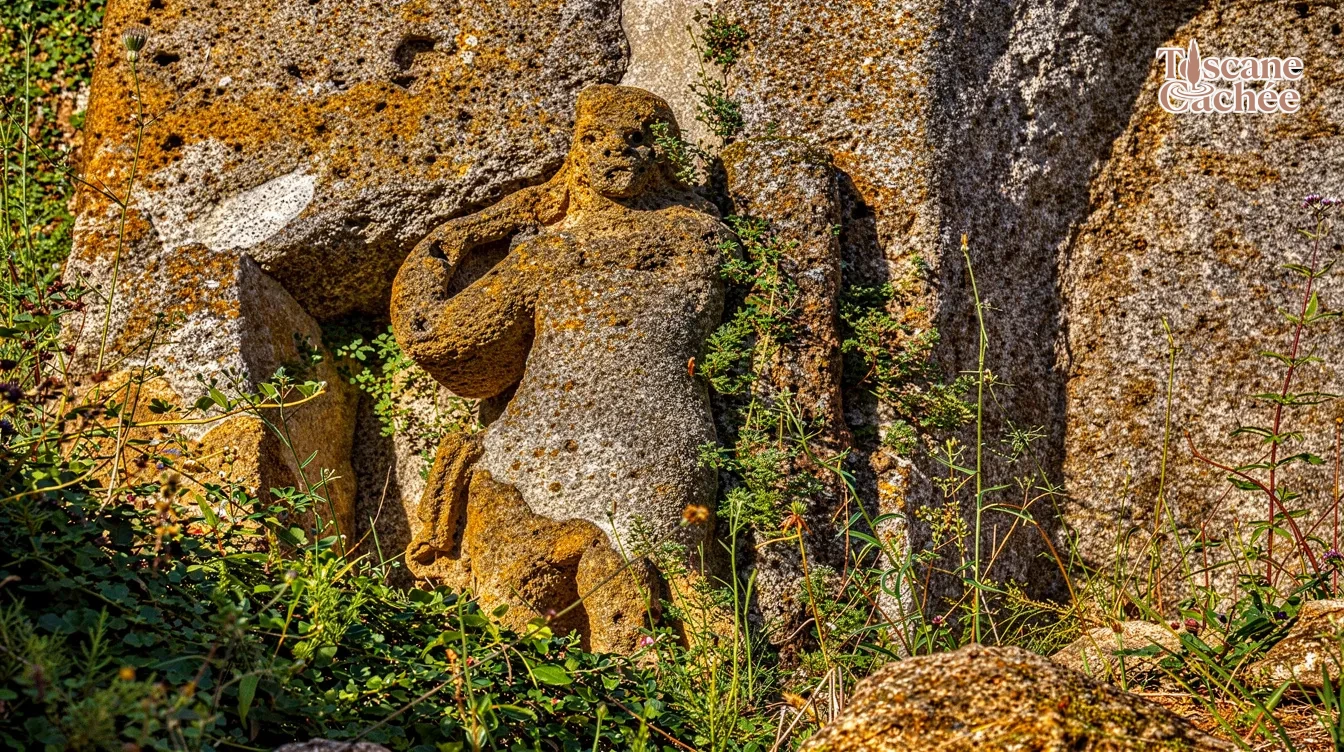
The Tomba della Sirena was not born yesterday. It was discovered in 1843 by an English landscape painter and archaeologist, Samuel James Ainsley, who initially named it «Tomba della Fontana». Shortly after, another British traveler passionate about Etruria, George Dennis, visited it and described it. It was Ainsley himself who renamed it «Tomba della Sirena», convinced that he could see a two-tailed siren on its pediment. Intriguing, isn't it? This interpretation, although popular, is subject to debate. The official interpretation leans rather toward Scylla, the sea monster of Greek mythology, embracing two Erotes. Others see in it a two-tailed siren, an Etruscan chthonian figure linked to Voltumna, also present on other tombs and buildings in the region. This mystery surrounding its identity only adds to its charm!
Carved between the end of the 3rd and the beginning of the 2nd century BC, this aedicula tomb testifies to the importance of Sovana at that time, even under Roman occupation. Its extended chronology – tombs dating from the 7th to the 2nd century BC can be found in the surrounding necropolises – proves the vitality of this city for nearly five centuries. The Maremma was then a beating heart of the Etruscan confederation, and the Tomba della Sirena is a poignant vestige of it. To learn more about this rich past, feel free to consult our guide on the’Tuscan Etruria.
What strikes you immediately is the ingenuity with which the Etruscans were able to shape the volcanic tuff. The Tomba della Sirena is part of the Sopraripa necropolis, a vast complex of tombs carved into the rock. It takes the form of a imposing rectangular façade, slightly flared, crowned by a cornice and topped with a pediment sculpted in bas-relief. It is there that the famous debate over the siren or Scylla lies. These bas-reliefs, although eroded by time and the elements (tuff is a fragile stone!), are of incredible fineness and reveal a deep symbolism linked to the protection of the dead.
At the center of this facade opens a niche arquée profonde. Inside, one can make out the remains of a kline, this banquet bed on which the statue of the deceased was laid. This representation of the banquet is a direct testimony to their vision of death, not as an end, but as a festive continuation of existence. On the sides of the niche, two figures in relief, a male and a female figure, watch over the deceased, perhaps deities of the afterlife or tutelary spirits.
The funerary chamber, the true «house» of the deceased, is underground and accessible by a short dromos. Rather small, it was intended for a single individual, Vel Nulina, son of Vel, as attested by an inscription. It probably housed his cinerary urn, as cremation was a common practice. An interesting fact: this chamber is not directly under the aedicula, suggesting that it may have been carved after the structure of the pediment. To discover other Etruscan wonders, don't miss visit the Tomba Pola, also in Sovana.
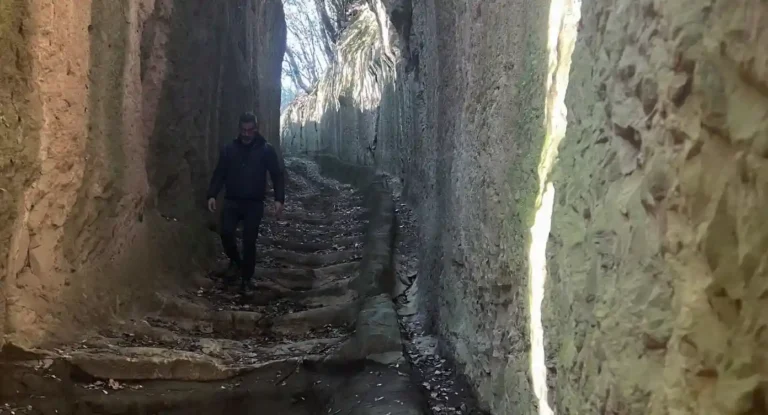
Visiting the Tomba della Sirena is much more than a simple archaeological excursion. It is a sensory experience. The humidity of the vie cave, those vertiginous sacred roads carved into the tuff, still echoes with the footsteps of the Etruscans. The wind whistling between the walls creates a particular, almost mystical sound atmosphere. It is a place charged with ancient energy, where the absence of crowds is an invaluable luxury. There one flees mass tourism for a raw and sincere immersion. If you love these ancestral paths, I invite you to explore the spectacular Etruscan vie cave of Maremma.
Ancient Tuscany is not told, it is lived. The Tomba della Sirena is one of those hidden gems that connects you directly to history. It is proof that the greatest treasures are often found where you least expect them, far off the beaten track. So, put on your best shoes, open your senses, and let this siren of stone whisper its secrets to you. You will not regret it. To extend your exploration of Etruscan treasures, discover the 5 must-see Etruscan archaeological sites in Maremma.
Evaluation criteria
Is the map not displaying? See accommodations on Stay22
Map and prices provided by Stay22: Toscane Cachée may receive a commission on bookings.
 Français Français
 Italiano
 English
 Polski
 Português do Brasil
 Nederlands
 Español
 Deutsch