










You think you're eating real Tuscan ham while the industry serves you bland factory-farmed white pork. Yet this rustic breed with a white belt came close to extinction before rebel farmers saved this unique heritage.
The secret of this cinta senese Tuscan charcuterie lies in its fat rich in oleic acid, which literally melts in your mouth. I'll explain how to spot the DOP seal so you never get fooled by industrial counterfeits again.
Cinta Senese: the treasure we nearly lost to industrial laziness
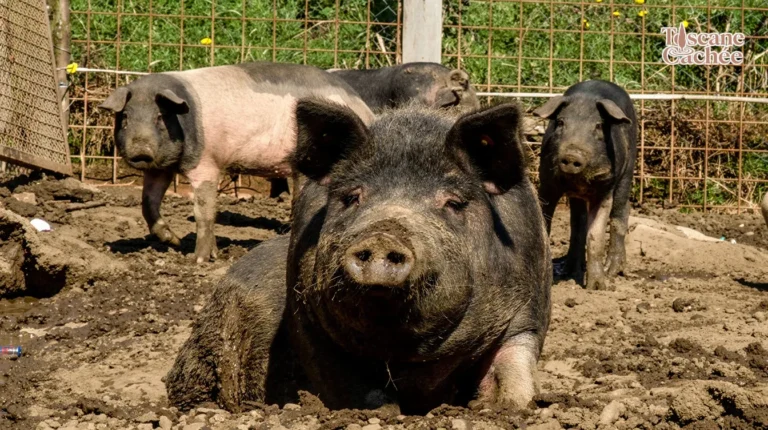
Cinta Senese
The Cinta Senese is a Tuscan pig breed with marbled meat, raised free-range, whose ham and salami are cited

Tosco Have fun spotting my white-belted cousin in the frescoes of the Palazzo Pubblico in Siena: he was already posing proudly there in 1338, long before becoming the must-have star of our *taglieri*!
Cinta Senese is a rustic pig breed from Tuscany, saved from extinction thanks to the DOP label obtained in 2012. Its extensive free-range farming in the forest guarantees meat rich in oleic acid, the basis of exceptional charcuterie.
This black pig, a true emblem of our hills, has come back from far after coming close to total oblivion because of productivist methods.
A miraculous survival in the face of pork uniformity
In the 90s, productivism nearly wiped out this black pig. Industrial white breeds, more profitable, had completely displaced it. Its slow growth no longer appealed to the factories.
Fortunately, rebel farmers protected this heritage, already celebrated in 1338 by Ambrogio Lorenzetti. Their efforts paid off.
Its current qualitative revival proves that peasant resistance works. It's a victory for taste.
Cinta means ‘belt’ in Italian, referring to the characteristic white band that surrounds the thorax of this black pig.
The white band on black background: the emblem of the terroir
The animal commands respect with its dark skin. Its famous cinta, this white belt, gives it the look of a living coat of arms. It is a magnificent spectacle in the undergrowth.
It is often found between oak forests and steep hills. To understand the beauty of its habitat, check out the Top 5 sea views from wild Maremma in 2026. It is there that he flourishes.
Its morphology is perfectly suited to walking in the forest. It is a rustic, powerful and independent athlete. We are far, very far, from a soulless factory-farmed product.
The DOP specifications: your only bulwark against fakes
To understand why this pig costs more, you must look at the strict rules governing its outdoor life.
Free-range extensive farming or nothing
The Cinta Senese DOP Consortium imposes a total freedom. The pigs must live in semi-freedom in the Tuscan pastures. This is a strict legal obligation.
Daily physical exercise radically transforms the flesh. The muscle strengthens without undergoing the stress of sheds. This avoids the acidity of industrial meat. The quality becomes exceptional.
You can observe these farms during your stay. It is a a memorable experience for understanding the product.
Acorns and chestnuts: the diet that changes everything
These pigs follow an authentic woodland diet. They root through the soil of oak forests. They devour acorns, roots and chestnuts. This is their natural food.
- Strict prohibition of GMOs in their feed.
- Drastic limitation of supplementary cereals.
- Richness in natural antioxidants from acorns.
- Whiter fat, rich in unsaturated fatty acids.
This natural diet shapes the final aromatic signature. You find the taste of the forest on the palate. This is what makes each slice unique and deep.
The secret of the fat: why it melts like butter
This forest diet is not just a matter of ethics, it literally transforms the molecular structure of the animal's fat.
Oleic acid: when the pig joins olive oil
Cinta fat is a biological anomaly. It is packed with unsaturated fatty acids. Its chemical composition is in fact close to that of olive oil.
| Characteristic | Industrial Pork | Cinta Senese DOP |
|---|---|---|
| Type of fat | Saturated (targeted leanness) | Unsaturated (oleic acid) |
| Melting point | High (stays solid) | Low (melts immediately) |
| Omega 3 content | Low (standardized) | High (acorn feeding) |
| Digestion | Slow and heavy | Fast and light |
This fat is much more fluid. It is also far healthier for your arteries. It is the true Tuscan good fat.
Texture and marbling: the raw sensory experience
Look closely at those fine white veins. This intramuscular marbling irrigates the muscle in depth. It is the guarantee of absolute tenderness on the palate.
Here, you are not just tasting salt. Notes of hazelnut are revealed. You can also sense the undergrowth and damp earth.
Imagine a slice of bacon on warm bread when you wake up. That is the soul of Breakfast in an agriturismo. A raw experience, far from industrial standards.
From ham to guanciale: what to demand on your plate
Now that you know why the meat is unique, let's see how artisans transform it into charcuterie gems.
Salami, Finocchiona and the art of Guanciale
The Prosciutto of Cinta Senese is the absolute centerpiece. Aged at least 900 days, it offers a long-lasting intensity on the palate. Its texture remains incredibly melt-in-the-mouth.
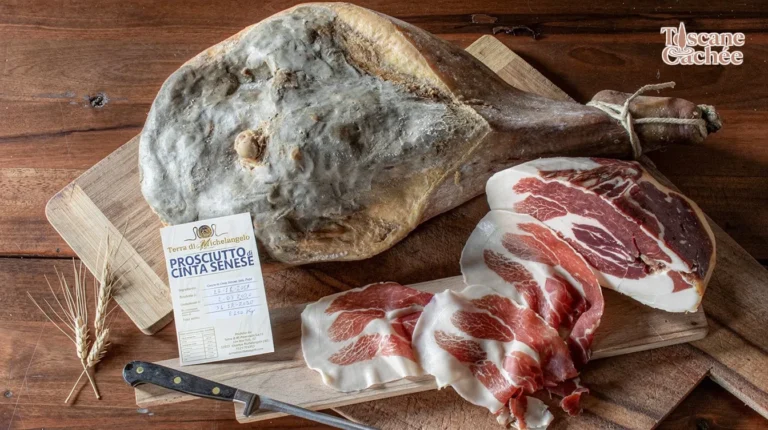
Cinta Senese prosciutto
Prosciutto di Cinta Senese comes from an indigenous Tuscan pig breed raised in freedom, a typical product of the terroir

Tosco Above all, do not commit the heresy of removing the white fat from your slice: at my belted cousins' place, that is precisely where all the flavors of acorns and chestnuts from our forests are concentrated!
Here are the specialties you absolutely must hunt down on the stalls:
- Guanciale: cured pork cheek, perfect for your pasta.
- Finocchiona: premium version of the salami Tuscan salami with wild fennel.
- Rustic salami : with earthy, deep flavors.
- Lardo : noble, unctuous fat that melts on the tongue.
Don't mix everything up. The guanciale is much firmer and more aromatic than classic pancetta. It's a matter of muscle.
To go further, discover the Maremma: the 10 specialties of Tuscan cuisine. It's the survival guide for your palate.
Forced pairings: which wines to jolt your taste buds
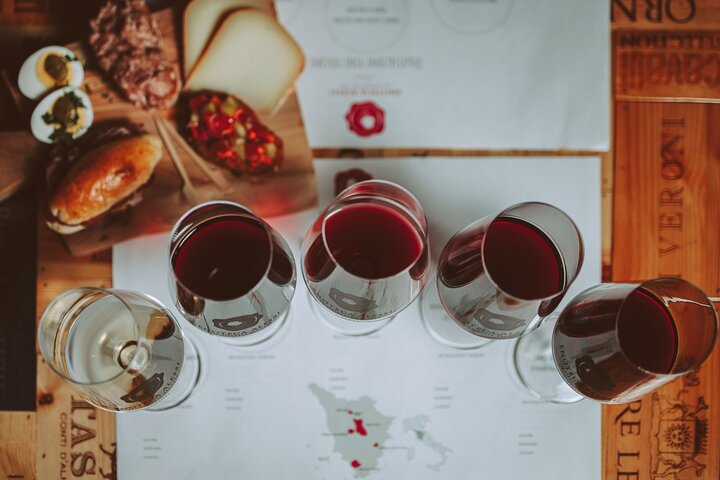
Let's talk about pairings. You need a red with real backbone. It's essential to cut through the fat of this charcuterie.
I suggest a Morellino di Scansano. A young Sangiovese also works very well. The grape's acidity cleanses your palate after each bite.
- Take the charcuterie out of the fridge 30 minutes before.
- Wait for the fat starts to become translucent.
- Slice thinly to release the aromas.
- Pair it all with a glass of local red.
Respect the product. The fat must start to turn translucent before you even touch it. That's where the magic happens.

Morellino di scansano DOCG
Morellino di Scansano is the Maremma's red DOCG, a Sangiovese grown over roughly 1500 hectares around Scansano, a village situated at 500 meters above sea level
Tosco Forget the severity of a Chianti: here, the sea breezes fill the Sangiovese with sun to give a much rounder and fruitier red, perfect to enjoy young with an aged pecorino!
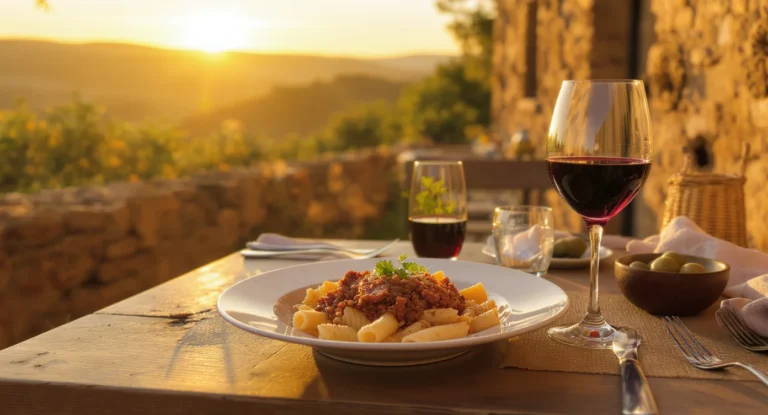
How to avoid being palmed off with disguised industrial pork
Success attracts fraudsters, so here's how to protect your wallet and your taste buds from counterfeits.
Spotting the DOP seal and official labels
The yellow and red PDO logo is mandatory. Without it, it’s not certified Cinta. It’s the only proof that the pig was born and raised in Tuscany.
Watch out for the price. If it costs the same as supermarket ham, run away. Quality and breeding time come at a price. A free-range animal is expensive to produce.
Absence of the yellow and red PDO logo, price too low (similar to the industrial one), lack of traceability of the Tuscan breeder.
Search for reliable artisan shops that still respect the product.
Conservation and respect for the artisanal product
Once opened, wrap it in a cotton cloth. Plastic suffocates the meat and alters the aromas. It’s the only way to let this noble fat breathe.
Avoid polar cold. The fat sets and loses its floral character below 10 degrees. Taste at room temperature. Take your charcuterie out of the fridge an hour before.
Buy in small quantities. It’s a living product that changes quickly once thinly sliced. Freshness guarantees that melt-in-the-mouth texture that you long for.
Choosing Cinta Senese PDO means demanding Tuscan charcuterie with fluid, healthy fat, the fruit of a wild life in the forest. This treasure saved from oblivion offers you a raw sensory experience, far from industrial standards. Ready to shake up your taste buds with the true taste of the land?
To make sure you buy genuine Cinta Senese DOP (Denominazione d’Origine Protetta) charcuterie during your trip to Tuscany, the first and most important visual marker is the presence of the official DOP logo. This logo, recognizable by its yellow and red colors, is a guarantee that the pig was born, raised and processed in Tuscany, according to a very strict set of specifications. Without this seal, it is simply not certified Cinta Senese. Beware of products whose label simply mentions «Cinta Senese» without the DOP designation, as they may come from Cinta Senese breed pigs raised in non-compliant conditions, or worse, it may just be a trade name.
Beyond the logo, pay attention to the price. Cinta Senese is an exceptional product, the result of extensive farming and long maturation. A price that is too low, comparable to that of standard industrial charcuterie, is an immediate red flag. The quality and the long rearing time of these free-roaming animals come at an inevitable cost. Favor buying from specialized artisan shops, direct farms (agriturismi) or local markets where producers can tell you about the origin and farming methods. Don’t hesitate to ask questions about the breeder and traceability. Authentic sellers will be delighted to share the story of their product. Finally, trust your senses: Cinta Senese charcuterie stands out for its fine marbling and fat that, at room temperature, should be translucent and melt-in-the-mouth, a sign of its richness in oleic acid. If the fat remains firm and hard, chances are it is not the product you are looking for. For foodies, I also recommend discovering the Maremma: the 10 specialties of Tuscan cuisine for other delights.
Absolutely! Observing Cinta Senese pigs in their natural environment is a fascinating experience that connects you directly to the essence of this exceptional product. Since their extensive forest farming is a sine qua non condition of DOP certification, many breeders open their doors to visitors. The Maremma, with its vast wooded expanses and hills, is an excellent starting point for this quest. I recommend looking for agriturismi or educational farms (fattorie didattiche) that offer guided tours of their farms.
These establishments are often located in the rural areas of the province of Siena, notably around the Montagnola Senese or in the Chianti, where oak and chestnut forests are abundant. You can contact local tourist offices in towns like Siena, Grosseto or smaller villages in the Maremma to get a list of breeders who are members of the Cinta Senese DOP Consortium and welcome the public. Some agriturismi even offer stays and tastings on site, allowing you to taste the charcuterie directly at the source. It is an excellent opportunity to understand the importance of the woodland diet (acorns, roots, chestnuts) and physical exercise for the quality of the meat. To admire the landscapes that serve as habitat for these animals, feel free to check out the Top 5 sea panoramas from the wild Maremma in 2026; even though the pigs are more inland, it will give you an idea of the region’s natural beauty.
You are absolutely right, the fat of Cinta Senese is one of its most distinctive and most valuable characteristics! Thanks to its open-air farming and its diet rich in acorns, roots and chestnuts from the Tuscan forests, this fat is exceptionally rich in unsaturated fatty acids, notably oleic acid. Its chemical composition is astonishingly close to that of olive oil, which makes it not only healthier for human consumption (less « bad » cholesterol) but also incredibly melt-in-the-mouth and aromatic. Unlike the saturated fat of industrial pigs, which often remains solid and pasty, that of Cinta Senese has a low melting point, which means it literally melts in your mouth, releasing complex flavors of hazelnut and woodland.
To enjoy it at its best, it is essential to follow a few simple rules. First, take your charcuterie out of the refrigerator at least 30 minutes to 1 hour before serving. The fat must reach room temperature for its floral, melt-in-the-mouth quality to be fully revealed; it should become slightly translucent. Next, slice it thinly. Whether it is prosciutto, lardo or guanciale, the fineness of the cut allows the aromas to be released and the fat to melt delicately. Pair it with good Tuscan bread and a local red wine, such as a Morellino di Scansano or a young Sangiovese, whose acidity will cleanse your palate after each bite and highlight the rich flavors of the charcuterie. For an authentic experience, imagine tasting a slice of lardo on warm bread during an Agriturismo breakfast; it is a true immersion in Tuscan culinary culture.
Yes, absolutely! Many agriturismi in Tuscany, especially those located in the traditional Cinta Senese farming regions, offer tastings and meals featuring this exceptional charcuterie. It is one of the best ways to discover the product in an authentic setting, often directly on the farm where the animals are raised. These establishments are generally committed to promoting local products and Tuscan gastronomic culture. You will find them mainly in the provinces of Siena and Grosseto, particularly in the rural areas of the Maremma, the Chianti et la Montagnola Senese.
To find them easily, I recommend consulting websites specialized in agriturismi in Tuscany, using search filters for « local products » or « farm with livestock ». Don’t hesitate to contact the agriturismi directly to inquire about their menus and tasting offers. Some even organize guided tours of their Cinta Senese farm. A good starting point would be to look for agriturismi that are members of the Cinta Senese DOP Consortium, as they are guaranteed to work with certified products. It is an immersive experience that will allow you not only to savor delicious dishes such as Cinta Senese prosciutto, guanciale or salami, but also to understand the deep connection between the terroir, farming and Tuscan gastronomy. Take advantage of these moments to chat with the owners; they are often passionate about their work and their products.
An excellent idea to want to incorporate Cinta Senese into your cooking! To bring back quality products, prioritize the emblematic specialties that showcase the unique qualities of this meat. Cinta Senese DOP Prosciutto is a must, aged for long months (often more than 900 days) for an intense flavor and a melt-in-the-mouth texture. Guanciale (cured pork cheek) is also a fantastic choice, essential for pasta dishes like carbonara or amatriciana, with a much more pronounced taste than pancetta. Don’t miss the Finocchiona (salami with wild fennel) and the Rustic Salami, which offer earthy, deep flavors. Lardo (noble, creamy fat) is another marvel, perfect for melting on warm bread or accompanying vegetables.
Once you are back home, storage is crucial to preserve the qualities of these artisanal products. For whole charcuterie or large pieces (such as a piece of prosciutto or salami), the best way is to wrap them in a clean cotton cloth or a kraft paper bag, and store them in a cool, dry place, ideally a cellar or pantry, at a stable temperature between 10 and 15°C. Absolutely avoid plastic or airtight containers, which suffocate the meat and alter its aromas. For pieces that have already been cut or sliced, store them in the refrigerator, still wrapped in a cotton cloth or parchment paper, and consume them within the following days. Remember that Cinta Senese fat is sensitive to extreme cold; always take the charcuterie out of the fridge an hour before tasting so that it regains its melt-in-the-mouth texture and aromas. Buy in small quantities to guarantee optimal freshness, as it is a living product that evolves quickly once cut.
Absolutely! The pairing between Cinta Senese charcuterie and Tuscan wines is a perfect marriage, where each element enhances the other. The aromatic richness and melting fat of Cinta Senese call for red wines with character and good acidity to cleanse the palate and balance the flavors. My number one piece of advice would be to go for a Morellino di Scansano. This wine, produced in the Tuscan Maremma region, is mainly made from Sangiovese (called Morellino locally) and offers a beautiful tannic structure, fruity notes and a refreshing acidity that pair wonderfully with black pork charcuterie. It is powerful enough to stand up to the intense flavors of Cinta Senese without overwhelming them.
Another excellent choice would be a young, fruity Sangiovese from the Chianti or other Tuscan appellations. The characteristic acidity of Sangiovese is a major asset to counter the fat of the charcuterie, while its cherry and spice aromas harmoniously complement the earthy notes of Cinta Senese. If you prefer wines with a bit more body, a Rosso di Montalcino, younger and more accessible than its big brother the Brunello, could also do the trick. The important thing is to choose a wine that brings freshness and liveliness to create a sensory balance. The tasting ritual is just as important as the choice of wine: take the charcuterie out of the fridge so that it reaches room temperature and serve the wine slightly chilled (around 16-18°C) to bring out its aromas. This is the guarantee of a memorable culinary experience, perfectly rooted in the Tuscan terroir.
Around this article
Cinta Senese
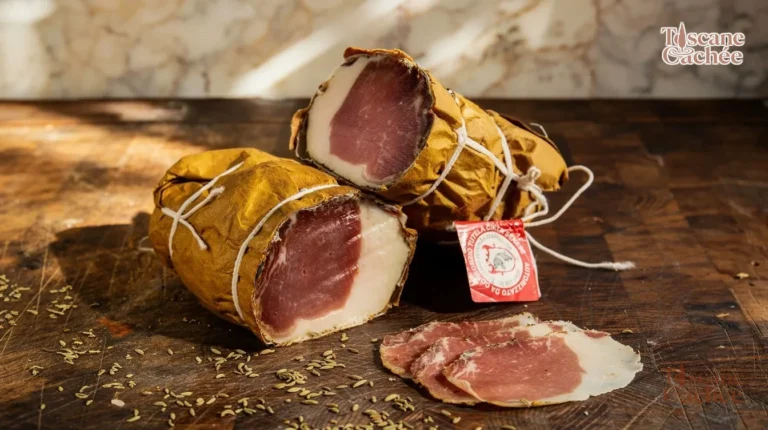
Cinta Senese charcuterie

Pici with wild boar ragù
Is the map not displaying? See accommodations on Stay22
Map and prices provided by Stay22: Toscane Cachée may receive a commission on bookings.
You will also like

Eating and drinking in Maremma: the guide to the real terroir 2026
Discover true Maremma gastronomy in 2026. Taste acquacotta and giant tortelli. Click…

Maremma: the 10 specialties of Tuscan cuisine
Discover Maremma specialties: acquacotta, wild boar and pecorino. A practical guide to tasting…

Breakfast at the agriturismo: jams and vineyard view
Enjoy an agriturismo breakfast at Podere Verdicchio: homemade cakes and olive oil'

Markets in Maremma: 6 places to taste the real Tuscany
Discover the best Maremma markets: from Orbetello bottarga to Pitigliano pecorino.…
